How tall is a beer can? Grab a can of beer from your fridge right now and look at it. You’ve probably never measured it, but you’ve handled hundreds of them, in cup holders, coolers, koozies, and six-pack rings. There’s a good chance you’ve never once wondered exactly how tall it is, until today.
Maybe you’re designing a label. Maybe you’re trying to figure out if a case of tallboys will fit on that one weird fridge shelf. Or maybe you just got into an argument with a friend about whether a “tallboy” is really that much taller than a regular can. Whatever brought you here, you’re about to get a straight answer, with real numbers, not vague guesses.
Here’s what you’ll walk away knowing: the exact height of a standard can, how that changes across every common size from mini to crowler, why two “12 oz” cans from different brands can measure slightly differently, and how U.S. cans compare to what you’d find in the UK or Australia. Let’s get into it.
Quick Answer
How tall is a beer can? A standard 12 oz beer can is 4.83 inches (12.3 cm) tall and 2.6 inches (66 mm) in diameter. This has been the U.S. industry standard since the 1980s and is what you’ll find on the vast majority of domestic lagers, from Budweiser to Coors Light.
That’s the short version. But “a beer can” isn’t just one size, so let’s break down every format you’re likely to run into.
Standard 12 Oz Beer Can: Full Dimensions
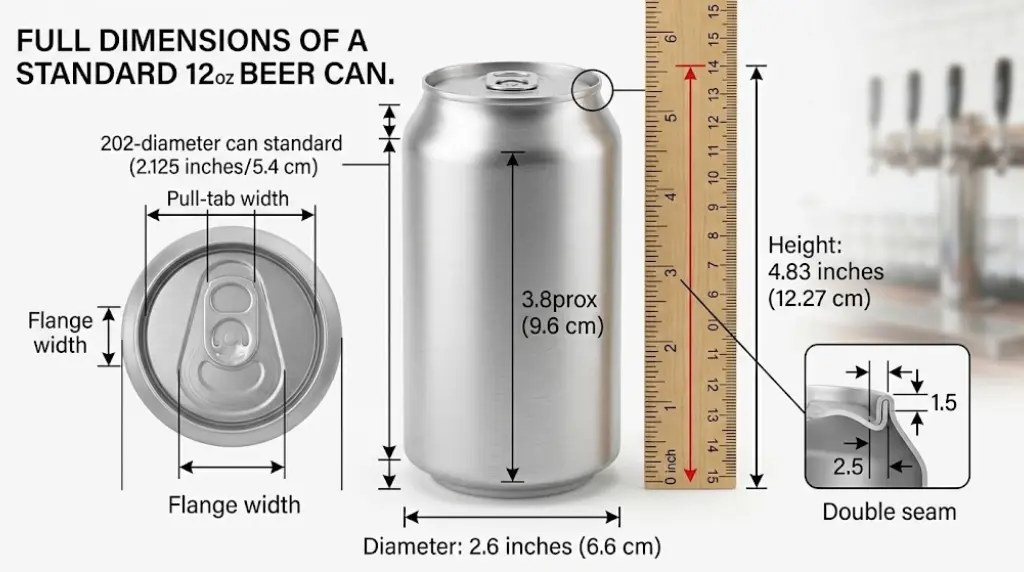
The 12 oz can is the workhorse of the beer industry. It’s the size you picture when someone says “a can of beer,” and it’s worth knowing its full spec sheet.
Height
4.83 inches (122.7 mm / 12.3 cm). This measurement runs from the bottom of the can to the top of the lid, including the slightly domed top that gives the can structural strength. This figure lines up closely with the published 202-spec sheet from the Can Manufacturers Institute, the U.S. trade body for the metal can industry, which lists the standard 12 oz cans flange-to-flange height at 4.812 ± 0.015 inches and body outside diameter at 2.602 ± 0.007 inches, essentially identical to the commonly cited 4.83″ x 2.6″ figures once you account for rounding.
Diameter
2.6 inches (66 mm) at the body. Interestingly, the lid itself is narrower, about 2.13 inches (54 mm),because can manufacturers taper the top inward to save aluminum and reduce production costs. In the industry, this is sometimes called a “211/202” can, a shorthand for the body and end diameters in sixteenths of an inch.
Circumference
Around 8.15–8.17 inches (207 mm), calculated using the simple formula: circumference = π × diameter (3.14159 × 2.6″). This number matters most if you’re designing a label, since it determines exactly how wide your wraparound artwork needs to be.
Volume in Metric
355 milliliters, the metric equivalent of 12 fluid ounces, and the number you’ll usually see printed on the can itself.
Can-End Codes: What “202” and “211” Actually Mean
If you’ve seen a can described with a number like “202” or “211,” that’s not a random model number, it’s the industry’s shorthand for diameter, expressed in sixteenths of an inch. A “202” end is 2 and 2/16 inches (2.125″) across; a “211” body is 2 and 11/16 inches (2.6875″, rounded to 2.6″ in most consumer-facing specs). These codes exist so manufacturers, fillers, and label printers can specify exact tooling without ambiguity.
| Code | Meaning | Approx. diameter | Typical use |
| 202 | 2 + 2/16″ | 2.125″ (54 mm) | Standard can lid/end |
| 211 | 2 + 11/16″ | 2.6875″ (66 mm, rounded to 2.6″) | Standard 12 oz / 16 oz can body |
| 300 | 3 + 0/16″ | 3.0″ (76 mm) | Wider-bodied formats like crowlers |
Beer Can Size Chart: Every Format Compared
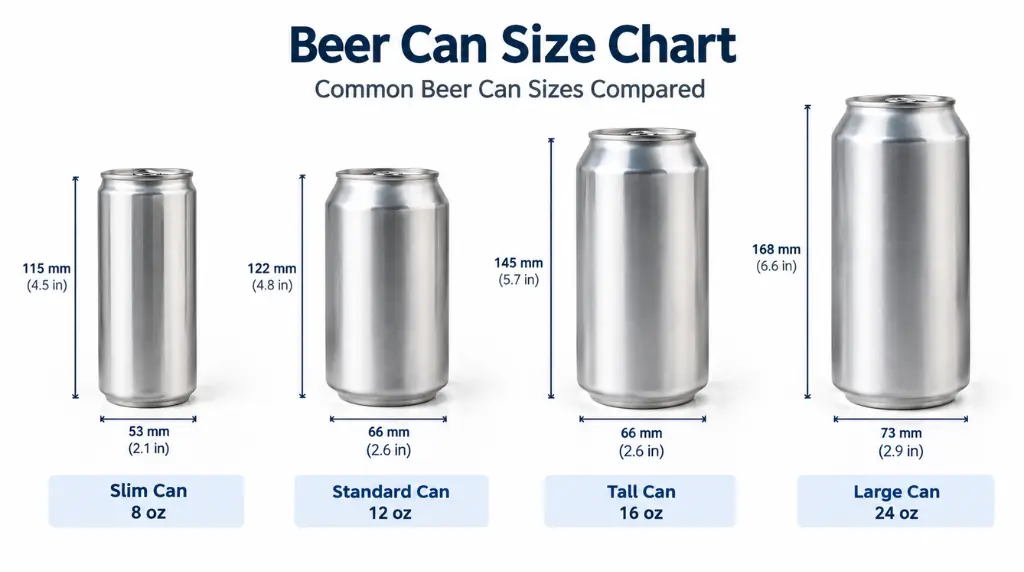
Not every can is 12 oz. Craft breweries in particular have pushed can sizes in both directions, smaller for variety packs, bigger for value and shareability. Here’s how the most common formats stack up.
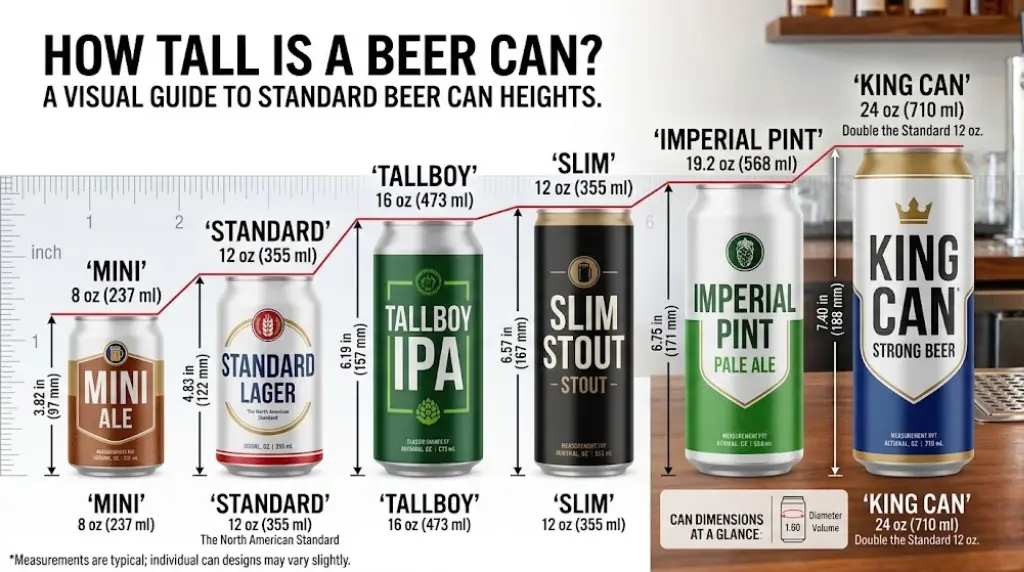
So, how tall is a beer can? It depends on the size and shape, with standard cans being shorter than tallboys, stovepipes, and crowlers.
Mini / Pony Can (8 oz)
Around 3.7–3.8 inches tall, roughly 2.25 inches in diameter. These show up in variety packs and are popular for lower-ABV or “session” beers where a full 12 oz might be more than you want.
Standard Can (12 oz)
4.83 inches tall, 2.6 inches in diameter the benchmark, as covered above.
Sleek / Slim Can (12 oz)
Around 6.1–6.25 inches tall but only about 2.25 inches in diameter. Same 12 oz volume as a standard can, just stretched taller and narrower. Brands use this shape for shelf visibility and a premium look, it’s common with hard seltzers and some craft lagers.
Tallboy (16 oz)
Roughly 6.19–6.2 inches tall, still around 2.6 inches in diameter. This is the size most people mean when they say “tallboy” today, though the diameter stays the same as a standard can, only the height changes.
Stovepipe (19.2 oz)
About 7 inches tall. Named for its taller, narrower silhouette, this size has grown fast in popularity since the mid-2010s, largely because it lets brands hit an odd volume point that reads as “more beer” without jumping all the way to 24 oz.
For a useful size comparison, 11 inches is just under a foot.
King Can / Oil Can (24 oz)
Around 7.4–8.5 inches tall, depending on the manufacturer’s exact shape. Sometimes called an “oil can” because of its resemblance to a can of motor oil. This size shows the widest height range of any common format, unlike the 12 oz and 16 oz cans, which share a single body tool across nearly the whole industry, 24 oz cans are made on a mix of body tooling: some manufacturers keep the standard 2.6″ diameter and stretch the height, while others widen the body toward the 2.87″–3.0″ range to keep the can more stable and easier to grip. That tooling difference, not measurement error, is why you’ll see genuinely different heights on 24 oz cans from different brands.
Crowler (32 oz)
Roughly 7.5–9 inches tall. This is less a “can you buy off a shelf” and more a to-go format, many breweries and taprooms fill an empty crowler fresh from the tap, seal it on the spot, and send you home with a sealed quart of beer.
Full Comparison Table
| Format | Volume | Height (inches) | Height (cm) | Diameter (inches) |
| Mini / Pony | 8 oz | 3.7–3.8″ | 9.4–9.7 cm | ~2.25″ |
| Standard | 12 oz | 4.83″ | 12.3 cm | 2.6″ |
| Sleek / Slim | 12 oz | 6.1–6.25″ | 15.5–15.9 cm | ~2.25″ |
| Tallboy | 16 oz | 6.19–6.2″ | 15.7 cm | 2.6″ |
| Stovepipe | 19.2 oz | ~7″ | ~17.8 cm | 2.6″ |
| King / Oil Can | 24 oz | 7.4–8.5″ | 18.8–21.6 cm | 2.6″–3.0″ |
| Crowler | 32 oz | 7.5–9″ | 19–22.9 cm | ~3.3″ |
Figures reflect commonly cited industry measurements. Exact height can vary slightly by manufacturer, see the next section for why.
Why Beer Can Heights Vary
If you’ve ever measured two “12 oz” cans from different brands and gotten slightly different numbers, you’re not imagining it. A few real factors are at play.
This is why how tall a beer can is can vary slightly even when two cans have the same volume.
Manufacturer Tolerance
Can manufacturing isn’t laser-precise down to the thousandth of an inch. The Can Manufacturers Institute’s own published spec sheet builds in a tolerance of roughly ±0.015 inches on standard can height and ±0.007 inches on body diameter,small enough that you’d never notice by eye, but enough to explain why one brand’s can measures 4.81″ and another’s measures 4.83″.
Sleek vs. Standard Shape
As covered above, a “sleek” 12 oz can and a “standard” 12 oz can hold the exact same amount of beer but look completely different. The sleek can trades width for height. If you’re comparing two cans and one looks noticeably taller despite the same volume printed on the label, this is almost always why.
Dome-Top Design
Modern cans use a slightly concave, dome-shaped top rather than a flat one. This isn’t decorative, it adds structural strength so the can can hold pressure (especially important for carbonated beer) without buckling. Different dome depths across manufacturers can add or subtract a small amount from the total measured height.
Beer Can Sizes Around the World
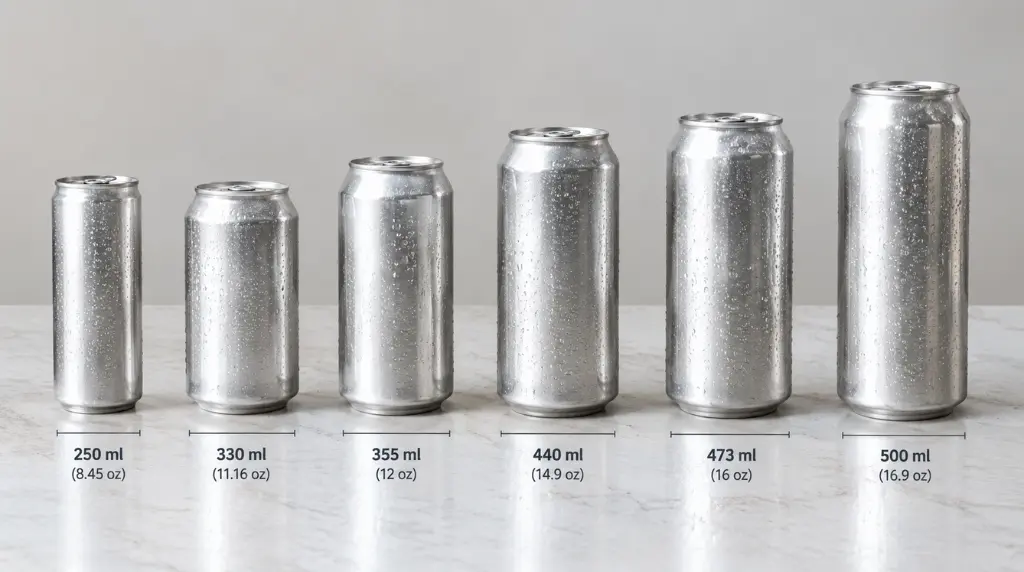
How tall is a beer can? Ask that question in the U.S. and you’ll get one answer. Ask the same question in London or Sydney, and the numbers shift because the underlying volume standard is different.
United States
12 oz (355 ml) is standard, with 16 oz tallboys and 19.2 oz stovepipes as common upsizes.
United Kingdom & Ireland
440 ml is the most common single-can size, noticeably bigger than the U.S. standard 355 ml can, and taller as a result.
Australia
375 ml is the traditional standard, though 330 ml cans are gaining ground in the craft beer segment.
Canada & EU
Canada largely mirrors U.S. sizing conventions, while EU countries commonly use 330 ml and 500 ml formats, following broader European beverage packaging norms.
International Size Table
| Region | Common Can Size | Approx. Height |
| United States | 355 ml (12 oz) | 4.83″ (12.3 cm) |
| United Kingdom / Ireland | 440 ml | ~5.2″ (13.2 cm) |
| Australia | 375 ml | ~4.9″ (12.5 cm) |
| EU (general) | 330 ml / 500 ml | Varies by format |
These differences come down to a mix of historical drinking culture, packaging regulations, and what each market has come to expect on shelf, not any single global “correct” can size.
Beer Can vs. Soda Can: Height Compared
Good news if you’ve ever used a soda can as a mental reference point: a standard 12 oz soda can and a standard 12 oz beer can are essentially the same size, both landing around 4.83 inches tall and 2.6 inches in diameter. Both industries settled on nearly identical dimensions decades ago, largely because they both benefit from the same manufacturing efficiencies, shelf-stacking logic, and case/pallet standardization.
Will It Fit? A Practical Sizing Guide
Knowing the number is one thing, knowing whether it’ll actually fit where you need it to is the real question. Here’s a quick practical breakdown.
Knowing how tall a beer can is makes it easier to choose the right size for cup holders, koozies, coolers, and fridge shelves.
Cup Holders
Most standard vehicle cup holders comfortably fit a 2.6″ diameter can (standard or tallboy). Sleek and slim cans, at roughly 2.25″ diameter, tend to fit even more loosely and may need a grip insert.
Koozies
Standard koozies are built for the 4.83″ x 2.6″ standard can. If you’re using a tallboy or stovepipe, you’ll need a specifically labeled “tallboy koozie”,a standard one won’t stretch far enough.
Cooler and Fridge Shelves
Fridge door shelves and cooler racks are usually designed around the standard can height. Tallboys, stovepipes, and 24 oz cans may not stand upright on a shorter shelf and often need to be laid on their side or stored in a taller compartment.
Cases and Pallets
Can height and diameter aren’t just about your fridge, they’re built around efficient case and pallet packing too. A standard case holds 24 cans (typically arranged 4 x 6), while six-packs and 12-packs use the same 2.6″ body diameter to nest tightly without wasted space. This is one of the underlying reasons the industry has stuck so closely to a single body diameter across the 12 oz, 16 oz, and 19.2 oz formats, changing the diameter would mean re-tooling the entire case and pallet layouts, not just the can line.
Quick Fit Checklist
- Standard 12 oz cans fit virtually any cup holder, koozie, or fridge shelf without adjustment.
- Tallboys (16 oz) fit most modern fridge doors but may be snug in older or compact models.
- Stovepipes and 24 oz cans often need a dedicated koozie and may not clear standard fridge shelving upright.
- Sleek/slim cans fit height-wise like a tallboy but need a narrower koozie or holder due to reduced diameter.
Why 12 Oz Became the Standard Size
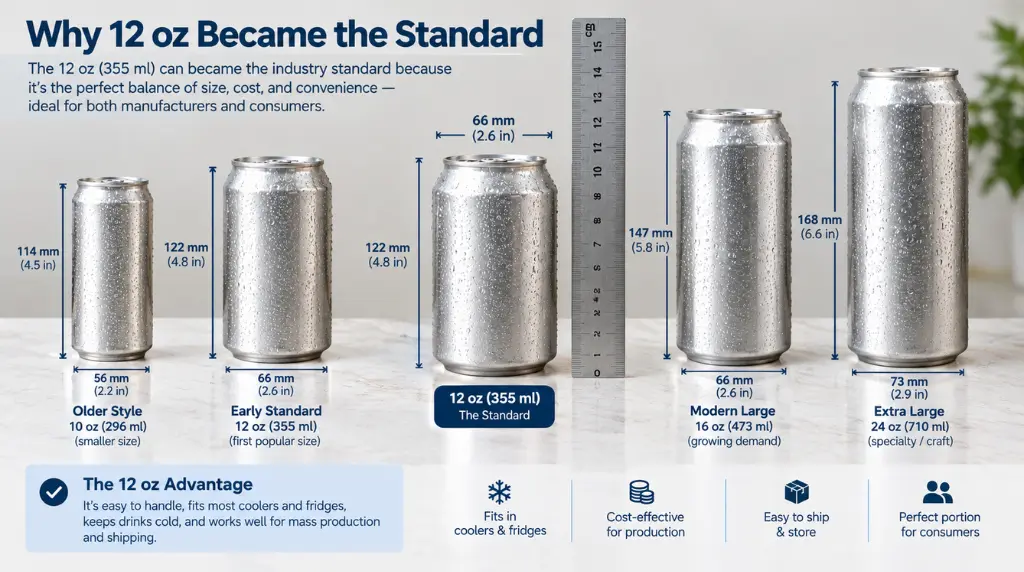
A Brief History
The 12 oz can wasn’t an arbitrary choice. As the beer industry shifted from steel to aluminum cans in the mid-20th century, brewers and manufacturers converged on 12 oz as the size that balanced a satisfying single serving, efficient shelf and case packing, and manufacturing cost. Once major domestic brands standardized around it, the entire supply chain, from can-making equipment to six-pack rings to store shelving, was built around that dimension, which is a big part of why it has remained essentially unchanged for decades.
Frequently Asked Questions
How tall is a 12 oz beer can?
A standard 12 oz beer can is 4.83 inches (12.3 cm) tall and 2.6 inches (66 mm) in diameter.
How tall is a 16 oz beer can (tallboy)?
A 16 oz tallboy is approximately 6.19–6.2 inches tall, keeping the same 2.6-inch diameter as a standard can, only the height increases.
How wide is a beer can?
Most standard and tallboy cans are 2.6 inches (66 mm) in diameter. Sleek and slim cans are narrower, at roughly 2.25 inches.
Are all beer cans the same height?
No. Height depends on volume and can shape. A 12 oz standard can, a 12 oz sleek can, and a 16 oz tallboy are all different heights despite two of them holding the same amount of beer.
How much does a full beer can weigh?
A full 12 oz beer can typically weighs around 0.78–0.80 lbs (about 355 grams of beer plus roughly 14 grams for the empty aluminum can itself).
How tall is a crowler can?
A crowler, typically 32 oz, generally measures between 7.5 and 9 inches tall, depending on the manufacturer.
Why are some beer cans taller than others?
It comes down to volume, shape choice (standard vs. sleek), and manufacturer tolerance. Brands also choose taller, narrower shapes deliberately for shelf standout and a more premium look.
What do the numbers “202” and “211” mean on a can spec sheet?
They’re diameter codes are measured in sixteenths of an inch, 202 means 2 and 2/16 inches (the standard lid), and 211 means 2 and 11/16 inches (the standard body). Manufacturers use these codes instead of decimal inches to keep tooling specs unambiguous.
Conclusion
How tall is a beer can? A standard 12 oz beer can measures 4.83 inches (12.3 cm) tall and 2.6 inches (66 mm) in diameter, a size that’s stayed remarkably consistent across the U.S. beer industry for decades, and one that lines up closely with the Can Manufacturers Institute’s own published spec sheet. From there, height changes predictably with volume and shape: mini cans run shorter at around 3.7 inches, tallboys stretch to roughly 6.2 inches, and formats like the stovepipe and crowler push past 7 inches.
Small variations between brands come down to manufacturing tolerance and shape choices like sleek vs. standard cans, not inconsistency in the underlying standard. Wherever you’re starting from, packaging design, cooler planning, or settling a bar bet, you now have the real numbers to back it up.