Every measurement in this guide is checked against a manufacturing standard, government spec, or physical count (like counting paper clips), not estimated by eye. Where a figure is a range rather than a fixed spec (phone height, mug height), we say so directly.
How long is 5 inches? Five inches is one of those measurements that sounds simple until someone actually asks you to picture it. You know it’s not tiny and not huge, but is it closer to your phone or your hand? A pen or a coffee mug? If you’ve ever stared at a product listing that says “5 inches” and had no idea what that actually meant for your space, you’re not alone.
This guide skips the guesswork. You’ll get the exact conversion, a real sense of where 5 inches lands on a ruler, and a list of everyday objects you can compare it to, including a few things people assume are 5 inches but actually aren’t. By the end, you’ll be able to picture 5 inches instantly, no measuring tape required.
How Long Is 5 Inches? Quick Answer
5 inches = 12.7 centimeters = 127 millimeters = 0.417 feet.
The math behind it is simple: 1 inch equals 2.54 centimeters (the official international conversion standard), so 5 inches works out to 5 × 2.54 = 12.7 cm.
In everyday terms, 5 inches is a little longer than a credit card, a little shorter than half a standard ruler, and just under the length of an average adult’s palm. The clearest reference object is the long edge of a 3×5 index card, that’s exactly 5 inches, by design.
5 Inches to CM, Quick Convert
If you just need the number: 5 inches = 12.7 cm, exactly, every time, it’s a fixed unit conversion (1 in = 2.54 cm), not an approximation that changes with context.
How Long Is 5 Inches on a Ruler?
Finding 5 Inches on a 12-Inch Ruler
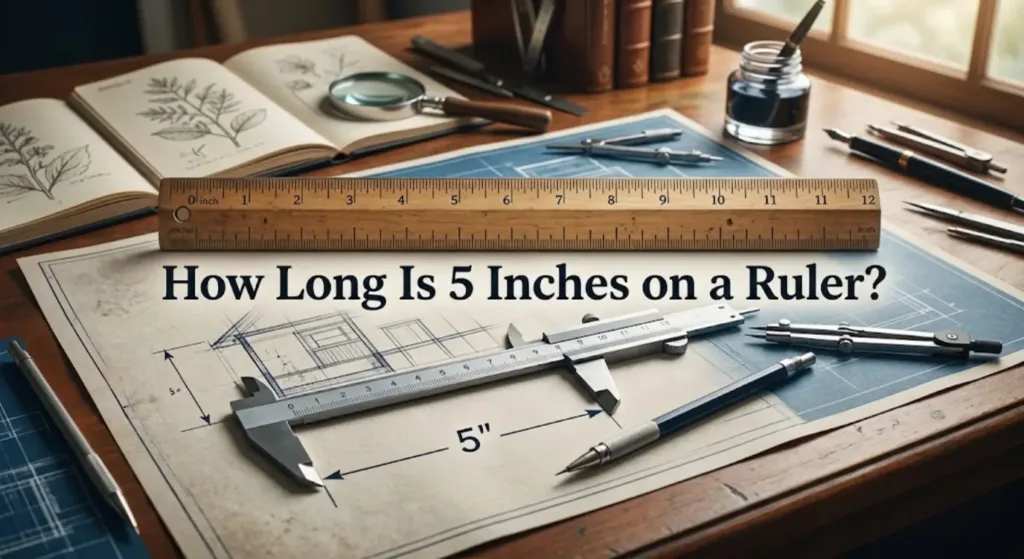
If you’re holding a standard 12-inch ruler, find the 6-inch mark (the halfway point) and back up one inch. That’s 5 inches. It’s a little less than half the ruler’s total length, close enough that eyeballing “about halfway” gets you in the right neighborhood, but not exact.
Finding 5 Inches on a 6-Inch Ruler
On a smaller 6-inch ruler, 5 inches takes up almost the entire length, stopping just one inch short of the end. If you’ve got a 6-inch ruler in a pencil case or sewing kit, this is the fastest way to see 5 inches in person.
Reliable 5-Inch References: Everyday Objects
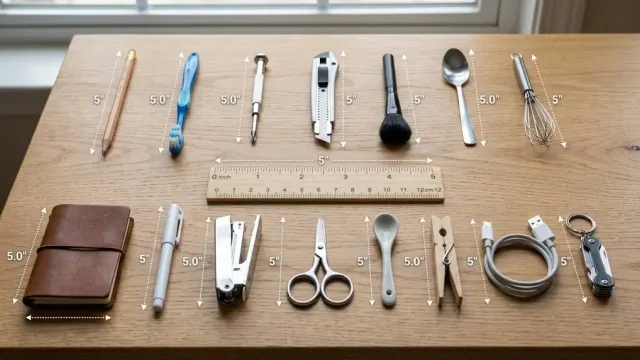
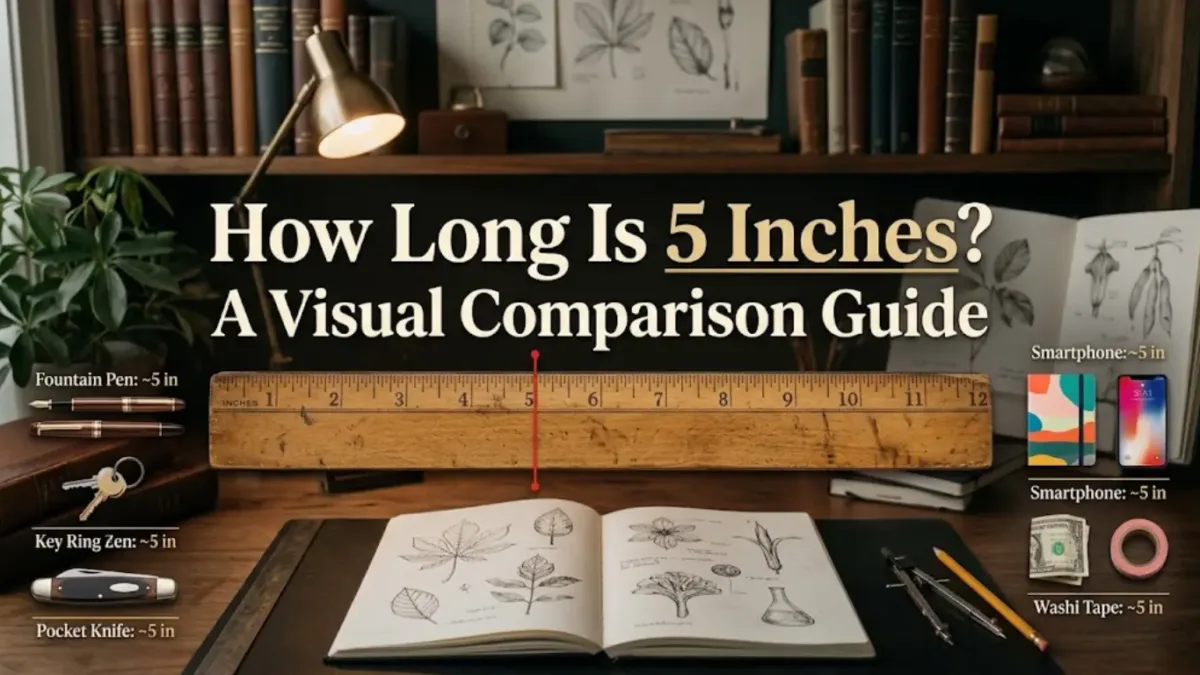
Numbers are abstract. Objects aren’t. If you’re wondering how long is 5 inches, here’s how 5 inches stacks up against things you likely have within reach right now. These are objects that are genuinely close to 5 inches, for objects people mistakenly believe are 5 inches, see the correction table below.
| Object | Approximate Length | How Close to 5″? |
|---|---|---|
| 3×5 index card (long edge) | 5 inches | Exact |
| 5 standard paper clips, end to end | 5 inches | Exact (by design) |
| Butter knife | ~5 inches | Very close |
| Nail file / emery board | ~5 inches | Very close |
| Ballpoint pen | 5–5.5 inches | Very close |
| Smartphone (compact models) | ~5 inches tall | Very close |
| US passport (height) | ~5 inches | Very close |
| Standard coffee mug (height) | ~4.5–5 inches | Close |
| TV remote (compact) | ~5 inches | Close |
| Small streaming stick | ~4.5–5 inches | Close |
Note: dimensions for consumer products like mugs, remotes, and phones vary by manufacturer and model treat these as reasonable ranges, not fixed specs.
Office & Stationery
The 3×5 index card is your most reliable reference here, its long edge is manufactured to exactly 5 inches, which makes it more dependable than most “eyeball” comparisons. Paper clips are just as precise: line up five of the standard 1-inch size end to end and you’ve got an accurate 5-inch benchmark. A ballpoint pen, by contrast, runs a touch longer, usually 5 to 5.5 inches, which is why pens have become a go-to informal ruler for quick estimates.
Tech & Everyday Carry
Compact smartphones measure close to 5 inches tall, making your phone a handy built-in reference, just measure yours once with a ruler and you’ll always have a 5-inch tool in your pocket. The same logic applies to compact TV remotes and streaming sticks, both useful if you’re trying to judge whether something will fit in a media console drawer.
Kitchen & Household
Most coffee mugs stand just under 5 inches tall, and the handle of many serving spoons measures close to 5 inches on its own, before you factor in the bowl of the spoon. A butter knife, the short, blunt-edged kind used for spreading, not the longer dinner knife, also lands right around 5 inches, and its rigid, flat shape makes it a surprisingly precise stand-in when you need a straight edge rather than a flexible one like a spoon handle.
Grooming & Personal Care
A standard nail file or emery board measures close to 5 inches, long enough for real leverage while shaping nails, short enough to fit in a makeup bag or pocket. It’s one of the more consistent references across brands, since the length is largely dictated by that same hand-ergonomics constraint that shapes a lot of the other objects on this list.
Objects People Think Are 5 Inches (But Aren’t)
A lot of measurement guides get sloppy here, so it’s worth setting the record straight. These are commonly cited as “5-inch objects,” but they’re actually off by a noticeable margin.
| Object | Common Claim | Actual Length | Source |
|---|---|---|---|
| Credit card | “About 5 inches” | 3.37 inches | ISO/IEC 7810 ID-1 standard |
| Standard soda can (height) | “5 inches” | 4.83 inches | Standard 12 fl. oz. can spec (industry-standard beverage can dimensions) |
| Playing card (long edge) | “5 inches” | 3.5 inches | Standard poker/bridge card size |
| US dollar bill (length) | “5 inches” | 6.14 inches | U.S. Bureau of Engraving and Printing |
None of these are wildly off, which is exactly why the confusion sticks around, they’re all “close enough” that people round to 5 inches from memory. But if you need real accuracy for a craft project or a tight-fitting space, reach for the index card or a ruler instead.
One Verified 5-Inch Fact Worth Knowing
Regulation golf balls have an official minimum diameter of 1.68 inches, set by the USGA and R&A Rules of Golf. Stack three of them and you’re at 5.04 inches, a near-exact, verifiable 5-inch reference if you happen to have a sleeve of golf balls lying around.
How to Estimate 5 Inches Using Your Body
Your hands are surprisingly reliable measuring tools once you know your own dimensions. (Hand size varies by person, so use these as starting estimates and check your own measurements once against a ruler.)
Palm and Hand Span
Most adult palms measure roughly 4 inches across, just below the knuckles slightly short of 5 inches, but close enough for a fast estimate. The distance from your wrist to the base of your fingers tends to land closer to the full 5-inch mark for many adults, though this varies by hand size.
Thumb Length
The average adult thumb, measured from tip to first knuckle, is about 1 inch. Five thumb-lengths stacked end to end gets you into 5-inch territory, though this method is rougher than using your palm or a pen.
Expert tip: Measure your own hand once against an actual ruler and jot the number down (or snap a photo with the ruler in frame). Once you know your palm width or thumb length precisely, you’ve got a portable measuring tool with you at all times, genuinely one of the most useful five minutes you’ll spend on this.
How to Measure 5 Inches Without a Ruler
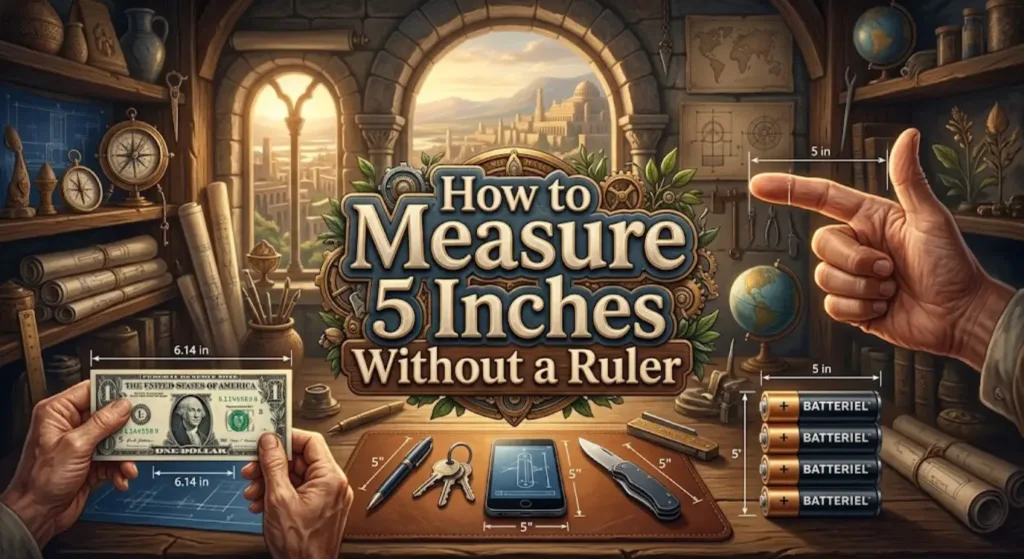
No tape measure nearby? Here’s a quick checklist of reliable stand-ins:
- Use a 3×5 index card: the long edge is exactly 5 inches.
- Line up 5 standard paper clips end to end.
- Grab your phone: if you’ve measured it once, you already know if it’s close to 5 inches.
- Use the Apple Measure or Google Measure app: both use your phone’s camera to estimate real-world distances, which is convenient for quick checks though less precise than a physical ruler.
- Fold a dollar bill: a US bill is 6.14 inches long, so folding in roughly an inch from one end gets you close to 5 inches (not exact, but useful in a pinch).
Is 5 Inches Big or Small? (Depends What You’re Measuring)
Context changes everything. Five inches means something different depending on what you’re sizing up.
| Category | Is 5 Inches Big or Small? |
|---|---|
| Phone screen (diagonal) | Small to mid-size by current standards; most modern phones run 6″+ |
| Kitchen knife (blade) | Small, a paring knife range, not a chef’s knife |
| Jewelry (necklace drop, bracelet) | Fairly large, noticeable length for pendants or charms |
| Planter or small container | Compact, suited for herbs or succulents, not larger plants |
| Notebook or notepad | Small, pocket-sized, not standard letter format |
If you’re shopping online and a product spec says “5 inches,” check which category it falls into before assuming it’ll be too big or too small. If you’re comparing different measurements, you can also see our guide on how long is 8 inches for a larger size reference.
FAQs
How long is 5 inches on a ruler?
On a 12-inch ruler, 5 inches is one inch short of the halfway mark. On a 6-inch ruler, it takes up nearly the full length.
How many cm is 5 inches?
5 inches equals exactly 12.7 centimeters. The conversion is 1 inch = 2.54 cm, so 5 × 2.54 = 12.7 cm, a fixed international standard, not an approximation.
What object is exactly 5 inches?
The long edge of a standard 3×5 index card measures exactly 5 inches, as does a line of five standard 1-inch paper clips laid end to end.
Is 5 inches the same as half a foot?
Not quite. Half a foot is 6 inches. Five inches is 0.417 feet, slightly less than half a foot.
How can I measure something without a ruler?
Use a 3×5 index card, line up five 1-inch paper clips, use your phone’s camera measuring app, or reference a pre-measured item like a pen or your own palm. See our full no-ruler measuring guide for more tricks.
Conclusion: How Long Is 5 Inches?
Five inches equals 12.7 centimeters (1 inch = 2.54 cm, so 5 × 2.54 = 12.7), and the easiest way to picture it is with a 3×5 index card, its long edge is exactly 5 inches, per standard stationery sizing.
It’s a little shorter than a US dollar bill, a little longer than a credit card, and roughly the height of a compact smartphone. Once you’ve measured one or two familiar objects against a real ruler, you’ll be able to spot 5 inches at a glance, no tape measure required.