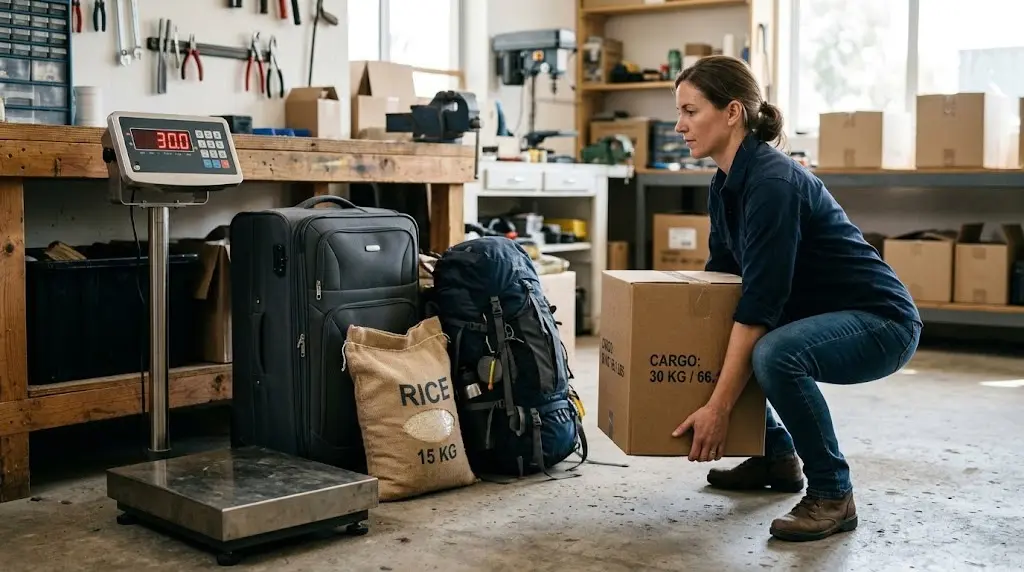
Picture eight one-gallon jugs of water in one bag. That’s about 30 kilograms, and you’d feel it long before you reached the end of the driveway.
So, is 30kg heavy? For most people who don’t lift regularly, yes. But how heavy is 30 kg, really? That depends on who’s lifting it, how far they’re carrying it, and what shape it’s in. A suitcase, a barbell, and an awkward sack can all weigh 30 kg and feel completely different.
Below you’ll find the straight answer, everyday comparisons, what the safety standards actually say, airline limits, and how to move 30 kilos without hurting yourself.
Quick Answer: Is 30kg Heavy?
Yes, for most adults who don’t lift regularly. 30 kg equals 66.14 pounds, above the 23 kg (51 lb) starting limit that NIOSH uses for ideal lifting conditions. Trained lifters can handle it. But carrying it any distance, or lifting it again and again, tires almost everyone.
Key facts at a glance
- 30 kg = 66.14 lb
- 30 liters of water = 30 kg (about 7.9 US gallons)
- NIOSH starting limit, ideal conditions: 23 kg (51 lb)
- UK HSE guideline filter, load held close at knuckle height: 25 kg (men), 16 kg (women)
- Standard US economy checked-bag limit: 50 lb (23 kg)
- Common maximum for a single checked bag: 32 kg (70 lb)
How Much Is 30 kg in Pounds?
Quick conversion
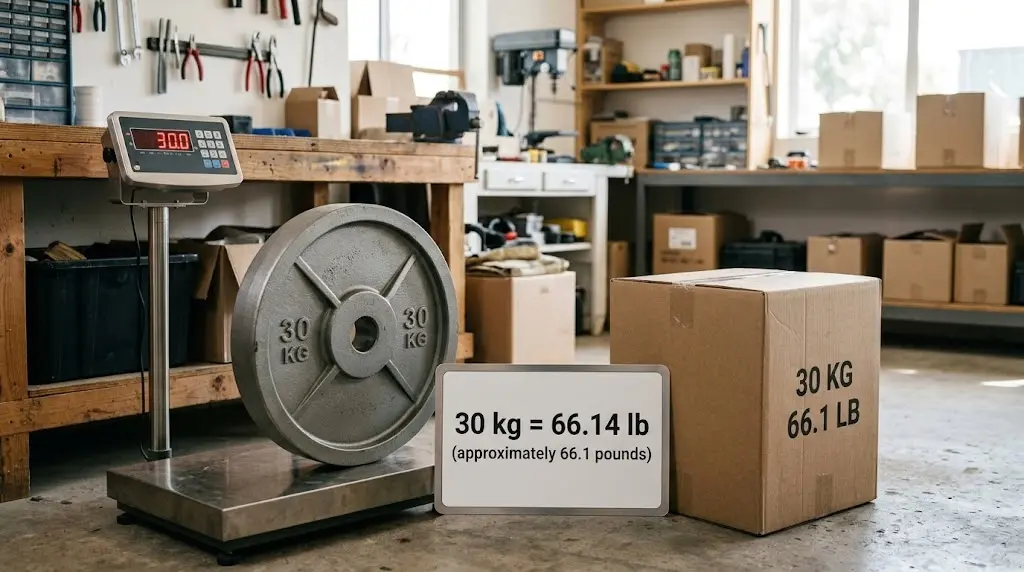
30 kg is 66.14 pounds. For everyday use, call it 66 lbs. If someone says “30 kilo” or “30 kilos,” they mean the same thing. “Kilo” is an everyday shorthand for kilogram.
Kilograms to pounds table
| Kilograms | Pounds (approx.) |
| 20 kg | 44.1 lbs |
| 23 kg | 50.7 lbs |
| 25 kg | 55.1 lbs |
| 30 kg | 66.1 lbs |
| 32 kg | 70.5 lbs |
| 40 kg | 88.2 lbs |
Mental-math shortcut
Double the kilos, then add a tenth of that. For 30 kg: 30 × 2 = 60, plus 6 = 66 lbs.
Is 30kg Heavy for Different People?
“Heavy” is personal. Fitness coaches point out that it depends on your experience and on what you’re comparing yourself to.
| Who | Is 30 kg heavy? |
| Beginner or occasional lifter | Yes, very |
| Average adult, one short lift | Challenging |
| Regular lifter, one controlled lift | Manageable |
| Anyone carrying it a distance | Tiring |
| Child or young teen | Not a sensible test |
| Anyone with back, joint, or heart concerns | Get advice first |
A general guide, not medical advice. If you have back, joint, or heart concerns, or you’re recovering from an injury, check with a doctor or physical therapist before lifting heavy loads.
Women and men
NIOSH designed its 23 kg starting figure around what roughly three in four women, and a larger share of men, would find acceptable under ideal conditions. UK guidance is more cautious. The HSE’s simple filter gives 25 kg for men and 16 kg for women when a load is held close to the body at about knuckle height, and less at other heights.
The HSE stresses that these are population-based guides, not safe limits or personal limits. Either way, 30 kg is above them.
Children and teens
30 kg is close to the median weight of a 10-year-old in US growth data, about 32 to 33 kg, so lifting it isn’t a sensible test of strength for a child. The American Academy of Pediatrics considers resistance training safe for young people when it’s well supervised and technique comes first. Hospital for Special Surgery advises starting without added resistance and avoiding maximal lifts until physical and skeletal maturity.
How Heavy Is 30 kg? Everyday Comparisons
Numbers are abstract. Objects are easier to picture.
Around the house
Water is the cleanest reference. One liter weighs one kilogram, so 30 liters weighs 30 kg. That’s about 7.9 US gallons, or roughly eight one-gallon jugs.
Compared with your own body weight
30 kg feels different depending on how much you weigh:
| Your body weight | 30 kg is about… |
| 50 kg (110 lbs) | 60% of your weight |
| 60 kg (132 lbs) | 50% |
| 70 kg (154 lbs) | 43% |
| 80 kg (176 lbs) | 38% |
| 90 kg (198 lbs) | 33% |
This is simple arithmetic, not a safety rule. But it explains why the same 30 kg feels far heavier to a smaller person.
What Does 30 kg Feel Like? Is 30kg Heavy in Real Life?
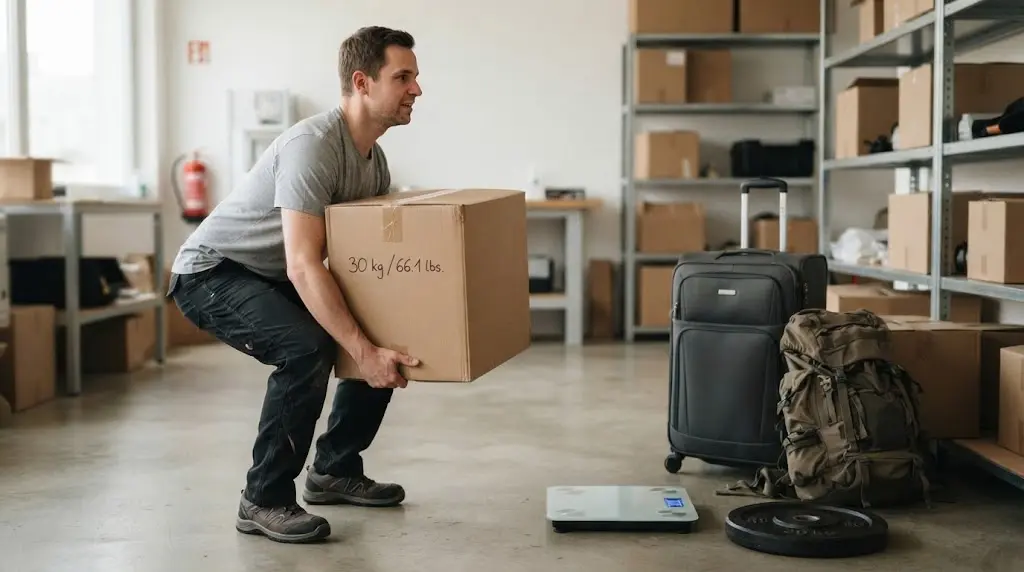
Lifting 30 kg once and living with it for a minute are different experiences. Lifting is a short burst of leg and back effort. Carrying is a grip and endurance test: your forearms burn, your shoulders drag, and the load wants to swing. Holding is harder still, because the working muscles never get a break.
Safety guidance reflects this. The HSE’s carrying filter assumes the load is held against your body and moves no more than about 10 meters without a rest (20 meters if it sits on your shoulder). NIOSH’s lifting equation goes further and assumes carrying is limited to a step or two and holding to a few seconds.
Shape matters too. The HSE lists bulky, hard-to-grasp, and unstable loads as risk factors in their own right, and NIOSH’s equation isn’t designed for unstable ones such as sloshing water or a half-full sack.
Is 30kg Too Heavy to Lift Safely?
What NIOSH’s 23 kg limit means
NIOSH is the US National Institute for Occupational Safety and Health. Its lifting equation produces a Recommended Weight Limit (RWL): the weight nearly all healthy workers could handle for up to eight hours without a higher risk of lifting-related low-back pain.
Under ideal conditions, the starting figure is 23 kg (51 lb). “Ideal” means the load is close to your body, at about knuckle height, moved a short distance, lifted occasionally, with no twisting and a good grip.
Two limits on that. First, it’s a workplace tool for healthy workers using two hands. Second, NIOSH’s own manual says it can’t predict any one person’s risk. Treat it as a yardstick, not a verdict.
Why real-world limits are lower
Real lifts are rarely ideal. So the equation multiplies the 23 kg by six factors, each between 0 and 1, and the result is the RWL. The Lifting Index is your actual load divided by that limit.
A worked example
Say you lift a 30 kg box off the floor, holding it 40 cm out in front of you, with no handles. Using the multipliers in NIOSH’s tables:
| Factor | Situation | Multiplier |
| Distance from body | Hands 40 cm out | 0.63 |
| Starting height | Floor level | 0.78 |
| Distance lifted | About 75 cm, floor to waist | 0.88 |
| Twisting | None | 1.00 |
| Frequency | Once, occasional | 1.00 |
| Grip | Poor (no handles) | 0.90 |
Multiply: 23 kg × 0.63 × 0.78 × 0.88 × 0.90 ≈ 9 kg. Divide 30 kg by 9 kg and the Lifting Index is about 3.3.
NIOSH’s goal is a Lifting Index of 1.0 or less. Above 1.0, some workers face increased risk. Above 3.0, experts agree nearly all workers would.
Even in the best case (load close, knuckle height, good grip), 30 kg gives an index of 1.3.
What other standards say
The UK’s Manual Handling Operations Regulations set no legal maximum weight, and the HSE says there’s no such thing as a “safe” weight. Its guideline figures simply flag when a closer risk assessment is needed. The international lifting standard ISO 11228-1 also uses 25 kg as an upper figure, according to one peer-reviewed paper.
| Guideline | Figure | 30 kg compared with it |
| NIOSH (ideal conditions) | 23 kg | 7 kg over |
| HSE filter, men | 25 kg | 5 kg over |
| HSE filter, women | 16 kg | 14 kg over |
| ISO 11228-1 (upper figure) | 25 kg | 5 kg over |
What OSHA actually says
You’ll sometimes read that OSHA caps lifting at 23 kg. It doesn’t. OSHA has no standard that sets a maximum weight a person may lift. It points to NIOSH’s model instead, and the 23 kg figure comes from NIOSH.
Is 30kg Heavy for a Suitcase?
For most economy tickets, yes: a 30 kg bag is over the limit. In premium cabins it’s often fine.
Airline limits
| Airline or standard | Typical limit |
| IATA guidance | Checked bags shouldn’t exceed 23 kg; 32 kg is the maximum for a single bag in many regions, including the US and EU |
| United, standard economy | 50 lb (23 kg) |
| United premium cabins and elite members | Up to 70 lb (32 kg) |
| Turkish Airlines | 23 kg economy, 32 kg business; no piece above 32 kg |
A 30 kg (66 lb) bag is above the standard economy limit but under the 32 kg (70 lb) ceiling.
Overweight fees
On US domestic economy fares, the first checked bag usually costs extra before any weight surcharge. On United, bags of 51 to 70 lb have generally drawn an overweight fee starting around $100, and United raised bag fees in April 2026. Fees vary by route, fare, and date, so check the airline’s fee calculator before you fly.
Planning a trip? See our baggage limits by airline guide.
Don’t forget the empty suitcase
A large 28-inch hard-shell case commonly weighs around 5 to 6.5 kg empty. Samsonite lists its models at 10.5 to 14.3 lb. On a 23 kg allowance, that leaves roughly 16.5 to 18 kg for your things. A cheap luggage scale at home can save you a fee at the airport.
How to Lift or Move 30 kg Safely
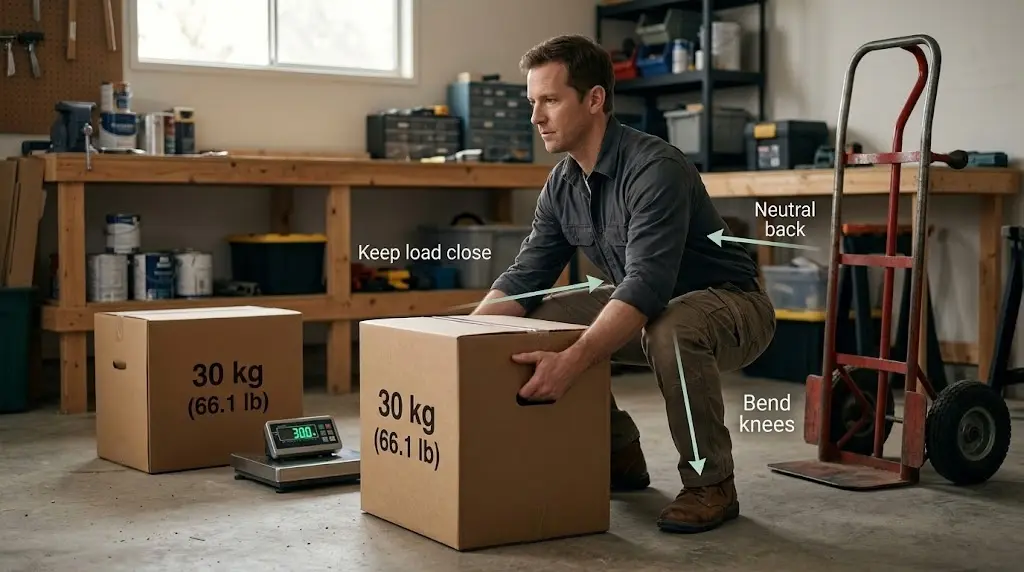
Step by step
- Check the load. Give it a small tilt first. If it feels too heavy, don’t lift it alone.
- Clear the path. Remove trip hazards and decide where you’ll put it down.
- Set your feet. Stand close, feet shoulder-width apart.
- Bend your knees. Keep the load close, brace your core, and lift with your legs, not your back. Use both hands and keep the load in front of you.
- Avoid twisting. Move your feet to turn.
- Set it down the same way. Lower with your legs.
For more, see our safe lifting guide.
Tools that make it easier
Use a dolly, hand truck, or luggage cart instead of carrying. Split the load into smaller parts where you can. The HSE notes that technique training alone can’t make up for a lack of mechanical aids, so the equipment matters.
When to ask for help
Ask for help when the load is awkward, the distance is more than a few steps, or you feel any pain. A two-person lift is normal, not a failure.
Is 30kg Heavy at the Gym?
A 30 kg dumbbell or kettlebell
Standard kettlebell sizes run 8, 12, 16, 24, and 32 kg, and some makers add 20 and 28 kg. Retailers and coaches commonly suggest starting at 8 to 12 kg for women and 12 to 16 kg for men. So a 30 kg bell is far beyond a starter.
Barbell math
An Olympic barbell weighs 20 kg. Add one 5 kg plate to each end and you get exactly 30 kg. Some gyms also have a lighter “women’s bar” at about 15.8 kg, so the total changes with the bar you use.
Progressing safely
The American College of Sports Medicine’s position stand suggests increasing the load by 2 to 10% once you can do one or two more reps than your target. Get the technique right before you add weight.
Common Mistakes and Myths
| Myth | Fact |
| OSHA caps lifting at 23 kg. | OSHA has no lifting-limit standard. The 23 kg figure comes from NIOSH. |
| 25 kg is a legal or safe limit in the UK. | It’s a risk-screening guideline. The HSE says there is no “safe” weight. |
| 30 kg is heavy for everyone. | Heavy is relative to your training, body weight, and the task. |
| If I can lift it once, I can carry it. | Carrying tests grip and endurance far more than one lift does. |
FAQs
Is 30 kg a lot of weight?
For most people who don’t train, yes. It’s 66 pounds, above NIOSH’s 23 kg and the HSE’s 25 kg (men) and 16 kg (women) guideline figures.
Can a woman lift 30 kg?
Many trained women can. As a guideline, though, the HSE’s filter figure for women is 16 kg. Individual strength varies widely, so build up gradually rather than testing yourself with 30 kg cold.
Is 30 kg over the airline limit?
On most economy tickets, yes. The standard is 23 kg (50 lb). Premium cabins on some airlines allow up to 32 kg (70 lb). Check your airline and fare.
How long can you carry 30 kg?
Not far, for most people. The HSE’s carrying filter assumes about 10 meters without a rest, and grip and forearm fatigue often stop you before your legs do.
Is 30 kg too heavy to lift?
It’s above NIOSH’s ideal-condition figure, so use good technique, aids, or a second person, especially for awkward or repeated lifts.
Can a 13-year-old lift 30 kg?
It’s not a good test of strength. Young people should build strength gradually under qualified supervision, with technique first and no maximal lifts until they’re physically mature.
Summary
Is 30kg heavy? For most everyday people, yes. At 66.14 pounds, 30 kg is a substantial load and sits above several commonly used lifting guideline figures. Trained lifters may handle it comfortably in controlled situations, while carrying or repeatedly lifting 30 kg can become much more demanding.