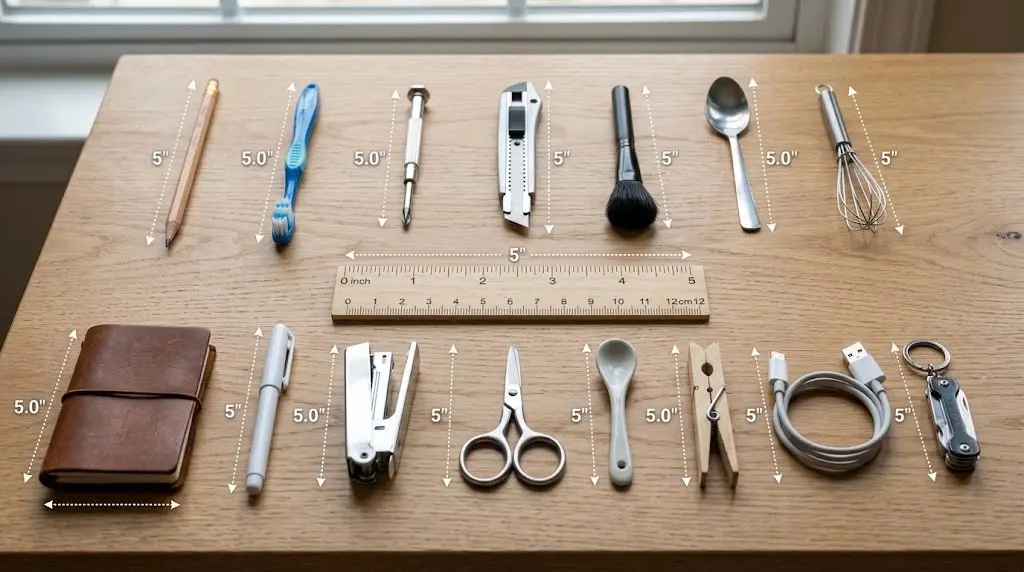
5 inch objects are all around you, from index cards and pens to soda cans and compact gadgets. But how long is 5 inches really? At 12.7 cm, five inches is easy to understand once you compare it with familiar everyday items.
The good news is you’re probably surrounded by 5-inch objects right now. Once you know what to look for, you’ll never have to guess again.
Quick Answer
5 inches = 12.7 centimeters = 127 millimeters. These 5 inch objects are easy to visualize using familiar items like a soda can, the long side of an index card, or a standard tablespoon.
What Is an Inch, Exactly?
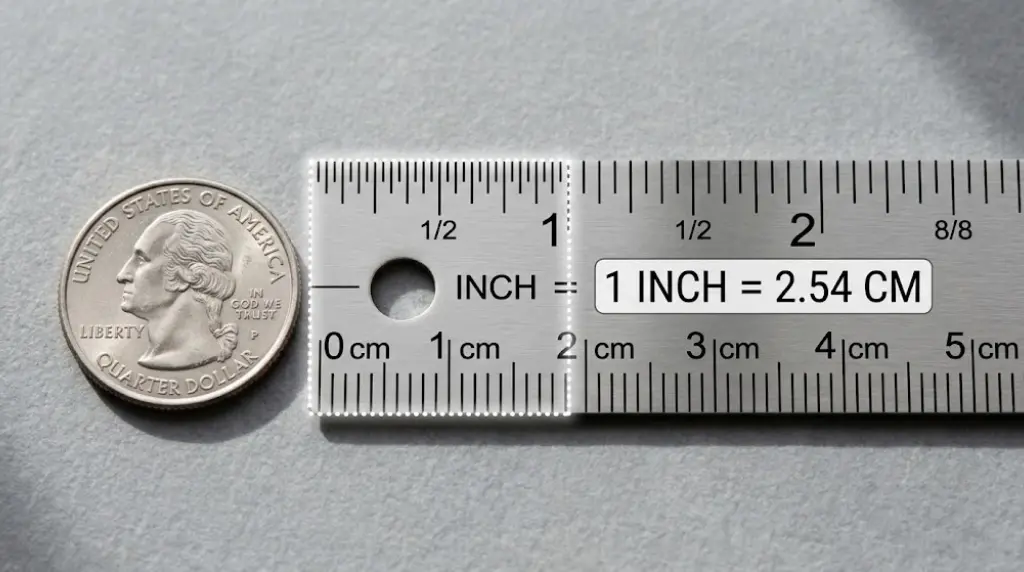
An inch is a unit of length in the imperial system, used mainly in the United States, defined as exactly 2.54 centimeters. Five of them stacked end to end give you 12.7 cm, the exact size this guide is built around.
How Long Is 5 Inches? (Conversion Chart)
| Unit | Value |
| Inches | 5 in |
| Centimeters | 12.7 cm |
| Millimeters | 127 mm |
| Feet | 0.417 ft |
Numbers alone don’t build intuition, though, 5 inch objects make the measurement much easier to picture. Here’s a full comparison table, followed by the details behind each one.
5 Inch Objects at a Glance
| Object | Approx. Length | Category |
| Index card (long edge) | Exactly 5 in | Office |
| Compact smartphone | ~5 in | Tech |
| Standard tablespoon | 5–6 in | Kitchen |
| Tall coffee mug | ~5 in | Kitchen |
| 5-inch utility knife | 5 in (by design) | Kitchen |
| Dollar bill (folded) | 5 in of a 6.14 in bill | Office |
| Uncapped standard pen | ~5 in | Office |
| Soda can + a sliver | 4.83 in + ~0.2 in | Household |
| Travel-size toiletry bottle | ~5 in | Household |
| Small picture frame | 4×5 or 5×5 | Household |
| Bracelet or short necklace | ~5 in (before clasp) | Fashion |
Size at a glance: the chart below lines up six of these objects against the 5-inch mark so you can see how close each one actually gets.
(See the size comparison chart above for how these objects stack up against the 5-inch mark at a glance, the golf hole comes in shortest at 4.25 in, and the tablespoon runs a bit long at 5.5 in, with index cards, folded dollar bills, and utility knives landing exactly on the mark.)
15 – 5 Inch Objects: Everyday Examples Explained
Tech & Gadgets
- Compact smartphones. Older or budget models, like the iPhone SE or an entry-level Android, typically run close to 5 inches long, screen included. That’s worth knowing, since most current flagship phones have grown to 6–6.7 inches, making a true 5-inch phone feel notably small by today’s standards.
- A computer mouse. Most standard mice measure approximately 4.5 to 5 inches from front to back, close enough to double as a rough reference when you don’t have anything else handy.
Kitchen Items
- A standard tablespoon. Most stainless-steel tablespoons found in a typical kitchen drawer measure roughly 5 to 6 inches from tip to handle, with the 5-inch mark usually falling right where the handle meets the bowl.
- A tall coffee mug. “Tall” style mugs, as opposed to shorter cappuccino cups, are commonly about 5 inches from base to rim, one reason they’re described that way on packaging.
- A 5-inch utility knife. This one’s not an estimate, it’s a genuinely named kitchen tool size. Cooks often reach for it as the “in-between” blade, smaller than a chef’s knife but bigger than a paring knife.
Office & Stationery
- An index card. The classic 3×5 card is exactly 5 inches on its long edge, making it one of the most reliable 5 inch objects and a no-guesswork reference you can find in almost any office or classroom.
- A US dollar bill. At 6.14 inches long, a dollar is a touch over 5 inches. Fold roughly an inch under at one end, and the remaining length lines up closely with 5 inches.
- An uncapped standard pen. Take the cap off most everyday pens and you’ll typically land close to 5 inches, a quick, always-in-your-bag reference.
Sports & Recreation
- Stacked baseballs. A regulation baseball measures about 2.9 inches in diameter. Two stacked comes to roughly 5.75 inches, so 5 inches is a bit under two baseballs high.
- A golf hole, plus a bit more. The regulation hole is 4.25 inches across. Picture that, then add about three-quarters of an inch, and you’ve landed on 5 inches, giving you another useful reference among 5 inch objects.
Household Items
- A soda can, plus a sliver. A standard 12-oz aluminum can stands about 4.83 inches tall. Add roughly the thickness of two stacked quarters, and you’re essentially at 5 inches.
- A travel-size toiletry bottle. Many airline-compliant shampoo, lotion, or hand-sanitizer bottles are designed close to 5 inches tall to maximize what fits in a quart-size bag.
- A small picture frame. 4×5 and 5×5 are two of the most commonly sold small-frame sizes, making them an easy visual reference if you have one on a shelf or desk.
- A compact TV remote. Simplified, minimalist remotes, the kind that ditch dozens of buttons for a clean design, often land right around 5 inches long.
- A bracelet or small necklace. Many bracelets and shorter necklace styles are made close to 5 inches around (before clasp or extension), especially those designed for smaller wrists.
5 Inches vs. Other Common Sizes
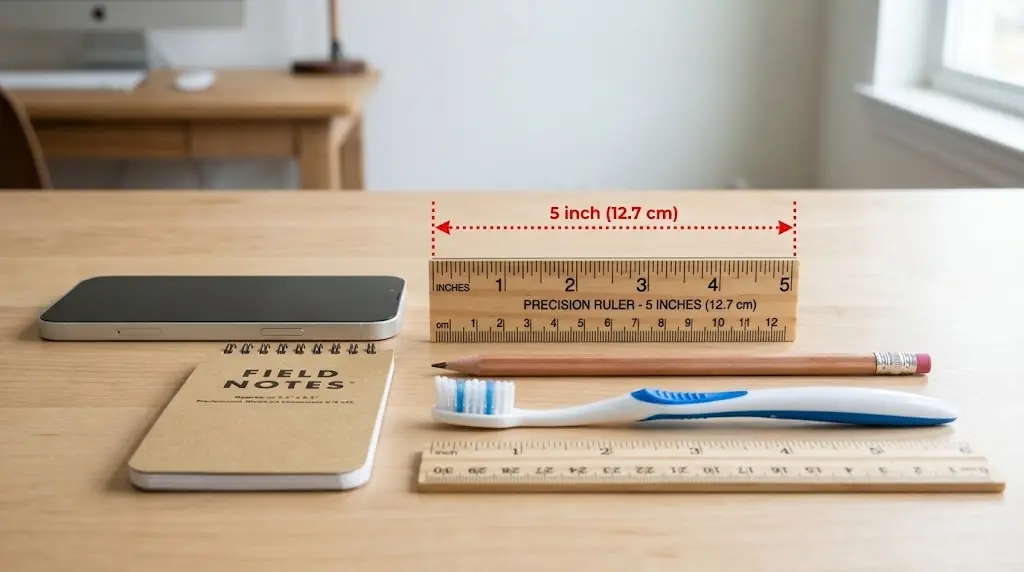
Numbers make more sense next to their neighbors. If you prefer metric measurements, our guide on how long 20 cm is provides another practical size comparison.
- 5 inches vs. 4 inches: 4 inches is roughly a credit card’s long edge. 5 inches adds about a thumb’s width.
- 5 inches vs. 5.5 inches: The difference is small, about the thickness of a stack of a few coins, but it’s the gap between an index card’s edge and a slightly longer item like an uncapped ballpoint pen.
- 5 inches vs. 6 inches: 6 inches is a standard dollar-bill length. 5 inches is about 14% shorter, the difference between an index card and a full dollar bill.
How to Measure 5 Inches Without a Ruler
No tape measure? These simple references can help you estimate 5 inch objects and 5-inch lengths without one.
- Fold a dollar bill. Tuck about an inch of one end under, and the remaining length is close to 5 inches.
- Stack two quarters on a soda can. The can plus two stacked coins gets you almost exactly there.
- Use an index card. If you’ve got one nearby, its long edge is already exactly 5 inches, no measuring required.
Common Estimation Mistakes
A few things trip people up when eyeballing 5 inches:
- Confusing screen size with device length. A “5-inch phone” usually refers to the diagonal screen measurement, not the total length of the phone body, the phone itself is often closer to 5.5-6 inches.
- Assuming all tablespoons match. Spoon length varies more than people expect between brands; use the bowl-to-handle taper point as your reference, not the very tip.
- Eyeballing from a photo. Product photos rarely include scale, and camera angle can make an object look larger or smaller than it really is, always check listed dimensions, not just the image.
Why This Measurement Matters
This isn’t just trivia. Knowing what 5 inches looks like has real, practical uses:
- DIY and home improvement: Spacing nails, cutting trim, or checking clearance often comes down to eyeballing small measurements fast, before you grab a tape measure to confirm.
- Packaging and shipping: Many small-item shipping boxes and padded envelopes are sized around 5 inches on at least one side, so knowing the size helps you judge packaging needs at a glance.
- Product fit checks: Wondering if a phone case, screen protector, or gadget accessory will fit? A quick mental 5-inch reference can save a return trip to the store.
For a deeper look at how 5 inches compares to nearby sizes, see our guides on 4 Inch Objects and How Long Is 5.5 Inches?, or check the official inch-to-centimeter standard from the National Institute of Standards and Technology for the exact conversion definition.
FAQs
How long is 5 inches on a ruler?
It’s exactly the halfway point past the 4-inch mark and just short of 6, five full inch-markers counted from the start of the ruler.
What household item is exactly 5 inches?
A standard 3×5 index card is one of the most reliable everyday references, its long edge measures exactly 5 inches by design.
Is 5 inches big for a phone screen?
By today’s standards, no, most current smartphones run 6 to 6.7 inches diagonally. A 5-inch screen is now considered compact or budget-tier, though it was standard a decade ago.
How many centimeters is 5 inches?
5 inches equals 12.7 centimeters, or 127 millimeters, based on the standard definition of 1 inch = 2.54 cm.
What’s bigger, 5 inches or 6 inches?
6 inches is bigger, about 20% longer than 5 inches, or roughly the length of a full dollar bill compared to an index card’s edge.
What is a good example of 5 inches?
An index card’s long edge is the most dependable single example, it’s manufactured to exactly 5 inches, unlike most everyday objects, which only approximate the size.
Is 5 inches considered small or average?
It depends entirely on context. For a phone or tablet, 5 inches is now small by current standards. For a kitchen knife or a bracelet, 5 inches is a completely normal, average size.
Summary
5 inch objects make it easier to understand how long 5 inches really is. This article compares the measurement with everyday items like index cards, phones, pens, soda cans, and dollar bills. It also explains common measurement mistakes and shows practical ways to estimate 5 inches without a ruler.