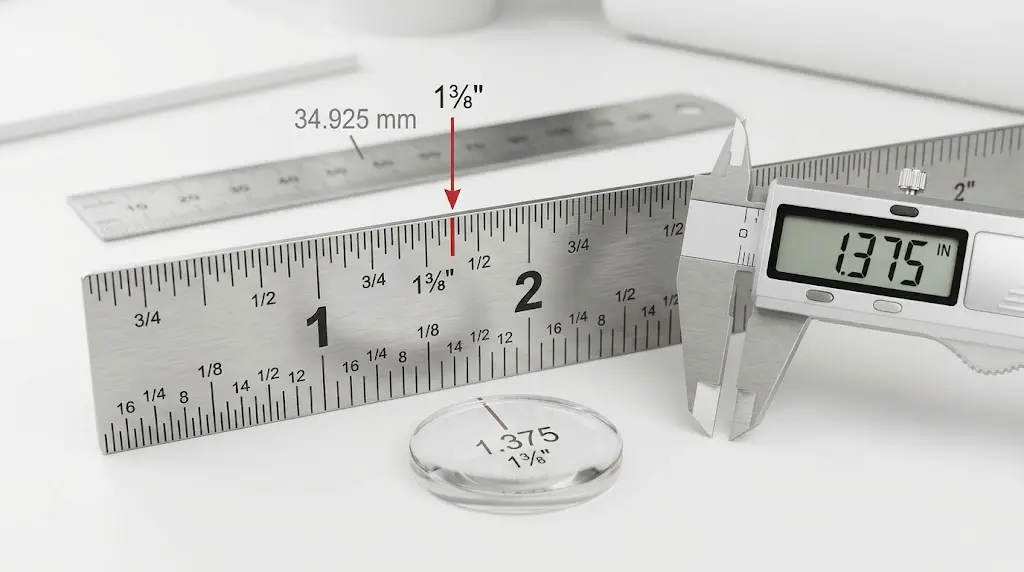
If you are searching for 1.375 to Inches, this guide explains what this measurement means, how it converts into fractions, and what it looks like in real life.
The thing that trips most people up: 1.375 is already a measurement in inches, written as a decimal. Your real questions are what it is as a fraction, where it sits on a ruler, what it converts to in millimetres, and what object is that size. This guide answers all four, and checks the object claims other sites make, because some do not survive the maths.
Quick Answer: 1.375 to Inches
1.375 inches is 1 3/8 inches, that is the fraction form. In metric, 1.375 inches equals 34.925 mm, or 3.4925 cm. In feet, it is about 0.1146 ft.
A note on the search itself: Google’s results for “1.375 to inches” treat 1.375 as a decimal inch value to translate into a fraction, metric units, and real-world size, so that is how this article treats it. If you started from 1.375 cm or 1.375 m instead, see the short section near the end.
What Does 1.375 Mean as a Fraction?
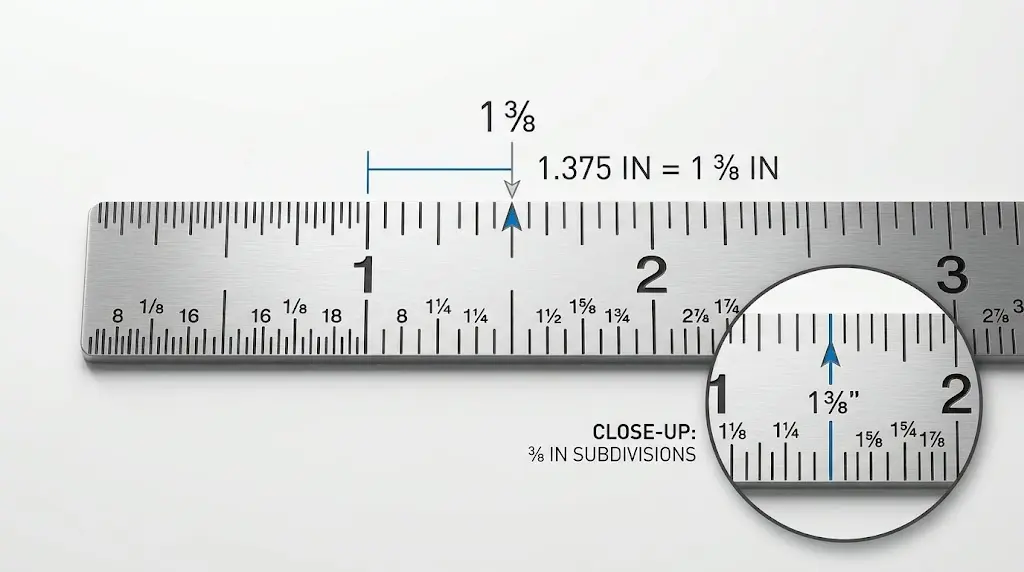
The 1.375 to Inches conversion is useful because hardware, woodworking, and rulers often use fractions instead of decimal measurements.
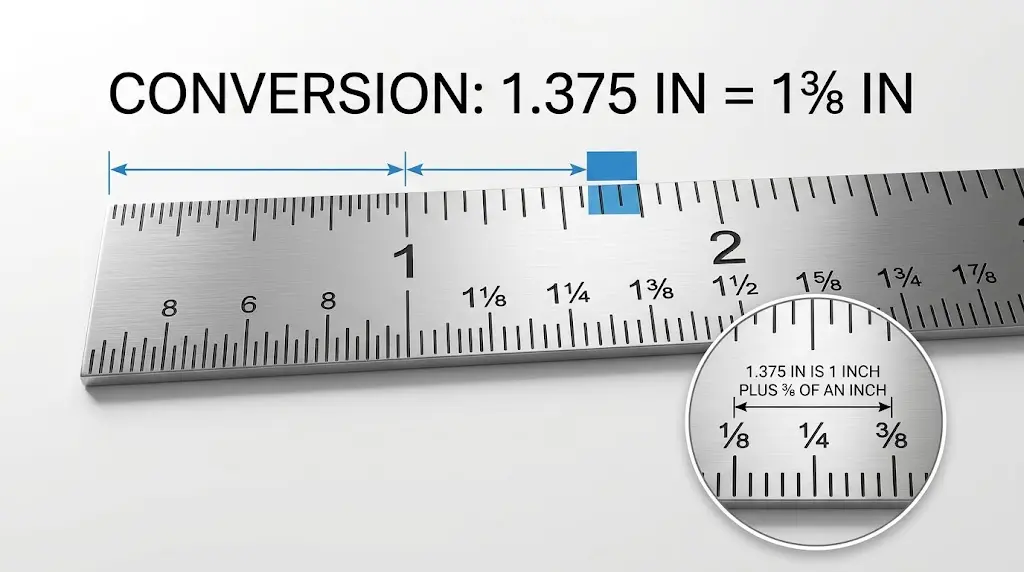
1.375 = 1 + 0.375, and 0.375 is exactly 3/8. So 1.375 inches is exactly 1 3/8 inches.
The maths is simple once you see the pattern. Each eighth of an inch is worth 0.125, so three eighths is 3 × 0.125 = 0.375. Add the whole inch and you land exactly on 1.375, no rounding. This decimal shows up so often because it is a clean, standard ruler fraction in decimal disguise. The Wood Database fraction and metric conversion chart lists the same pairing: 1 3/8″, decimal 1.375, 34.93 mm.
You may also see 1.375 written as 11/8 inches, the same length as an improper fraction, but on rulers, tape measures, and packaging, 1 3/8 is the form to look for.
1.375 Inches in mm, cm, Feet and More
For 1.375 to Inches conversions, remember that 1.375 is already a decimal inch measurement. You can convert it into millimetres, centimetres, metres, and feet using standard conversion formulas.
| Unit | 1.375 Inches Equals |
|---|---|
| Fraction | 1 3/8 in |
| Millimetres | 34.925 mm |
| Centimetres | 3.4925 cm |
| Metres | 0.034925 m |
| Feet | 0.11458 ft |
| Yards | 0.03819 yd |
| % of one foot | 11.46% |
Two plain-language anchors: at just under 35 mm, this is a small measurement; and at 0.11458 ft, it is a little more than one-ninth of a foot, not one-eighth, a common mix-up covered in the mistakes section. A converter check returns the same figure: 1.375 inches to millimetres is exactly 34.925 mm. Our guides to how long 20 cm is and how long 5 inches is use the same verified approach for nearby lengths.
How to Find 1.375 Inches on a Ruler
Understanding 1.375 to Inches makes it easier to locate the correct measurement on a ruler. Rulers and tape measures divide each inch into 16ths, with longer lines for quarter and half marks. To find 1.375 inches, start at the 1 inch line and count the eighth-inch marks past it: 1 1/8, 1 1/4, then 1 3/8, the third eighth-mark (sixth sixteenth-mark) after the 1.
It helps to see 1.375 against its neighbours, since confusing it with the mark either side is the easiest error at this size:
| Fraction | Decimal | mm | Position vs 1.375 in |
|---|---|---|---|
| 1 1/4 in | 1.250 | 31.75 mm | 1/8 in (3.175 mm) shorter |
| 1 5/16 in | 1.3125 | 33.34 mm | 1/16 in (1.59 mm) shorter |
| 1 3/8 in | 1.375 | 34.925 mm | — |
| 1 7/16 in | 1.4375 | 36.51 mm | 1/16 in (1.59 mm) longer |
| 1 1/2 in | 1.500 | 38.10 mm | 1/8 in (3.175 mm) longer |
Notice the pattern: 1.375 sits exactly halfway between 1 1/4 and 1 1/2. Find the quarter mark and the half mark, and 1 3/8 is the eighth-mark right between them the fastest way to eyeball it on any tape measure.
Everyday Objects That Are Really About 1.375 Inches
This is where most guides get sloppy, repeating object claims without checking them. Every object below was verified the same way: its real, documented dimension in millimetres, divided by 25.4. To count as a close match, an object must land within about 5% of 34.925 mm, the best ones land within a fraction of a percent.
| Object | Its Actual Size | In Inches | How Close to 1.375 in |
|---|---|---|---|
| Width of a strip of 35mm film | 34.976 mm | 1.377 in | Within 0.2% |
| Stack of 20 US quarters | 20 × 1.75 mm = 35.0 mm | 1.378 in | Within 0.2% |
| 35mm concealed-hinge cup hole (and the Forstner bit that drills it) | 35 mm | 1.378 in | Within 0.2% |
| #1 paper clip (retailer-listed size) | 1 3/8 in listed | 1.375 in | Listed as exact; check yours |
| A walnut in its shell | roughly 32–38 mm across | roughly 1.26–1.50 in | Approximate, natural variation |
The Width of 35mm Film — the Best Match of All
A genuinely satisfying fact: 35mm film is not just close to 1.375 inches, it started out as 1 3/8 inches. As the history of the 35 mm format records, the width was originally specified as 1 3/8 inches, and the modern standard width is 34.976 mm, 1.377 inches, within 0.2% of 1.375. If you have held a roll of camera film or a strip of negatives, you have held almost exactly this measurement.
A Stack of 20 Quarters
Coins are precision-made, which makes them trustworthy references. A US quarter is 1.75 mm thick, per US coin size specifications, and 20 × 1.75 mm = 35.0 mm, a stack of twenty quarters stands 1.378 inches tall, within about 0.2% of 1.375 inches. Hold on to that maths; it matters in the next section.
A 35mm Hinge Hole or Forstner Bit
If you do woodworking or furniture repair, you may already own this measurement. The cup hole for a standard European concealed cabinet hinge is drilled at 35 mm diameter, usually with a 35 mm Forstner bit, 1.378 inches. Imperial hardware makes the same point: tubing, sockets, and hole saws are routinely stocked at 1 3/8 inch, a standard step on the ruler.
A #1 Paper Clip — With an Honest Caveat
Paper clips are the classic answer for this size, and there is real support for it: retailer specifications for #1 paper clips list a length of 1 3/8 inches, and some clips are sold at exactly 1-3/8 inch length. But honesty matters, other listings for similar clips say 1.3 inches (about 33 mm), and clip sizing is not as standardised as coin or film dimensions. Use the clip in your drawer as a good approximation, and measure it once against a ruler if the exact size matters.
Natural and Body References (Approximate Only)
A walnut in its shell is typically around 32–38 mm across, so an average one is in the 1.375 inch neighbourhood, but nuts are natural objects, and any single walnut can miss by several millimetres. The same goes for your thumb: many adults find their thumb width lands near this size, but thumbs vary far more than film or coins. Treat both as visualisations, not measurements.
Objects That Are NOT 1.375 Inches (Despite What Some Sites Say)
Because this keyword attracts copycat lists, a few wrong claims have been repeated until they look like facts. Each fails the basic check, real size in millimetres, divided by 25.4:
- A six-quarter stack. Some popular lists claim six stacked quarters reach exactly 1.375 inches, citing the quarter’s 0.069 inch thickness. But 6 × 0.069 in is 0.414 inches, less than half an inch. You need twenty quarters.
- A vintage 38mm ping pong ball. The old pre-2000 ball was 38 mm across, and 38 ÷ 25.4 = 1.496 inches, a 1 1/2 inch ball, not 1.375. The current 40 mm ball is bigger still at 1.575 inches.
- An AA battery’s diameter. An AA battery is about 14.5 mm thick, 0.57 inches, nowhere near this measurement. Its length (about 50.5 mm) overshoots the other way at roughly 2 inches.
- Casino dice and binder clips. Claims that casino dice or medium binder clips are exactly 1.375 inches do not hold up as general statements, die and clip sizes vary by product, and no standard spec puts either at this figure.
The lesson: at small sizes, a claim is only worth repeating after one division. That is the standard applied to every object in this article.
How to Measure 1.375 Inches Without a Ruler
No ruler nearby? You still have options, in rough order of reliability:
- Use a strip of 35mm film. Its width (34.976 mm) is within 0.2% of 1.375 inches. Old negatives work perfectly.
- Stack 20 quarters. At 1.75 mm each, the stack is 35 mm, close enough for any everyday purpose.
- Mark it once. Mark 1 3/8 inches on a card or tape with any ruler or ruler app, and keep it in your wallet or toolbox.
- Use a #1 paper clip, then verify it. Clip sizes vary by brand, so check yours once; after that it is a pocket-sized gauge.
- Coin-width shortcut for a rough estimate. One quarter (0.955 in) plus roughly half of another quarter’s width is fine for eyeballing, but treat it as an estimate, not a measurement.
For comparison, our 5 inches comparison guide walks through the same no-ruler tricks at a larger size.
Where You Will See 1.375 Inches in Real Life
This decimal turns up often, usually in its 1 3/8 fraction form:
- Hardware and fasteners. Screws, bolts, and fittings are sold in 1 3/8 inch lengths and diameters, and 1.375 inch outside-diameter tubing is a stocked product size.
- Woodworking. Fraction-to-decimal charts hang in workshops precisely because dimensions like 1.375 appear on plans and bit packaging.
- Product dimensions. Small parts and fittings often list 1.375 inches when the underlying design was drawn in fractions, and the 35mm film format, still the reference for “full frame” sensors, traces back to this width too.
One habit when fit matters: check whether a listing means 1.375 inches exactly, or was rounded from 35 mm, a 0.075 mm difference, invisible daily but relevant in a press fit.
Did You Mean a Different Unit? 1.375 cm and 1.375 m in Inches
If your 1.375 was not in inches to begin with, the answers change completely:
| If You Meant | In Inches | Also Equals |
|---|---|---|
| 1.375 cm | 0.541 in | 13.75 mm |
| 1.375 m | 54.13 in | 137.5 cm / about 4 ft 6 in |
| 1.375 ft | 16.5 in | 41.91 cm |
For the record: centimetres convert by dividing by 2.54, metres by multiplying by 39.3701. Neither reading relates to this article’s subject beyond sharing the digits.
Common Mistakes With 1.375 Inches
- Reading 1.375 as 1.375 cm. Identical digits; the size differs by a factor of 2.54. Check which unit the source used, our guide to 11 inches shows how often listings mix units without saying so.
- Thinking 1.375 inches is one-eighth of a foot. It feels tidy, but one-eighth of a foot is 1.5 inches. 1.375 inches is 11.46% of a foot, closer to one-ninth.
- Rounding it to 1.4 inches. A 0.025 inch rounding sounds harmless, but it is 0.635 mm, enough to matter for a drilled hole or tight-fitting part.
- Trusting object lists without checking. As the claims above show, “exactly” is the most abused word in size articles. Divide by 25.4 before relying on any of them, including ours, which is why we showed our working.
- Confusing 1 3/8 with 1 5/8. On a crowded tape, the third and fifth eighth-marks blur together, count them if the cut matters.
FAQs
What is 1.375 as a fraction in inches?
Exactly 1 3/8 inches. The decimal part, 0.375, is three-eighths of an inch (3 × 0.125), so nothing is rounded or lost.
How many mm is 1.375 inches?
34.925 mm. Multiply any inch value by 25.4 to get millimetres: 1.375 × 25.4 = 34.925.
How many cm is 1.375 inches?
3.4925 cm just under 3.5 cm, the same length as 34.925 mm in centimeters.
Where is 1.375 inches on a ruler?
Count three eighth-inch marks past the 1 inch mark: 1 1/8, 1 1/4, 1 3/8. It sits exactly halfway between 1 1/4 and 1 1/2 inches.
What everyday object is 1.375 inches?
The most accurate match is the width of a strip of 35mm film at 34.976 mm (1.377 in), a format originally specified as 1 3/8 inches. A stack of 20 US quarters (35 mm) is equally close.
Is 1.375 inches the same as 35 mm?
Nearly. 35 mm is 1.378 inches, a difference of 0.003 inches (0.075 mm). Interchangeable for everyday purposes; for precision work, use the exact figure you were given.
Summary
The 1.375 to Inches conversion gives a precise result: 1.375 inches is exactly 1 3/8 inches, 34.925 mm, 3.4925 cm, and about 0.1146 ft. On a ruler it is the third eighth-mark past 1 inch, halfway between 1 1/4 and 1 1/2.
To picture it, think of the width of a strip of 35mm film, a format literally designed at this size, or twenty quarters stacked flat. And if another source tells you a ping pong ball or half a dozen quarters measure 1.375 inches, you know how to check: real size in millimetres, divided by 25.4.