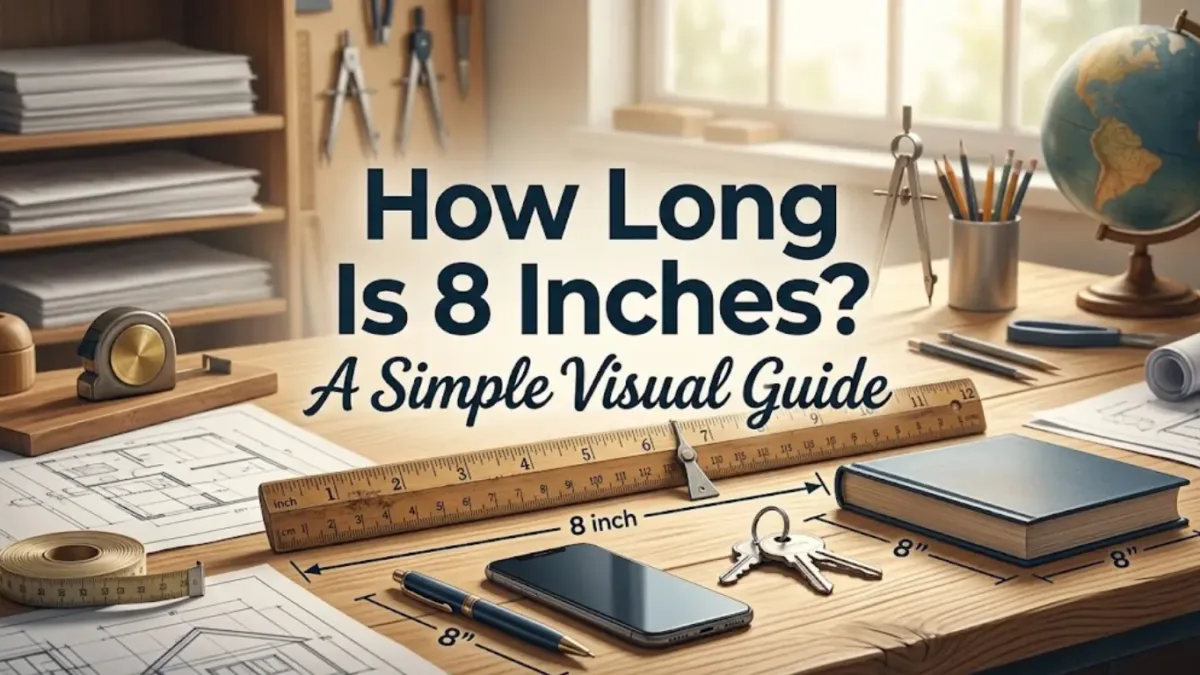
You’re scrolling through a product listing, and there it is: “8 inches.” The number sits there, technically precise and completely useless to your brain. Is that big? Small? About the size of your hand? Your phone?
Most of us don’t think in inches, we think in objects. That’s exactly why “8 inches” on a spec sheet is so hard to picture, even though it’s a completely ordinary linear measurement you’ve handled a hundred times without noticing.
This guide fixes that. In the next few minutes, you’ll know exactly how long 8 inches is, see it through everyday objects you already own, and pick up a no-ruler trick to measure it yourself, anytime, anywhere.
Quick Answer
8 inches = 20.32 cm = 203.2 mm = 0.67 feet = 0.22 yards.
An inch is a unit of length used mainly in the United States, defined internationally as exactly 2.54 centimeters, a standard formalized in the 1959 international yard-and-pound agreement recognized by NIST. Eight inches works out to about the length of a standard chef’s knife blade, an unsharpened pencil, or two credit cards laid end to end with a thumb’s width to spare. It’s noticeably longer than half a foot but still well short of a full 12-inch foot, a comfortable, mid-range length that shows up constantly in kitchens, on desks, and in tech gadgets.
Wait – Which “8 Inches” Do You Mean?
Before diving into objects, it’s worth clearing up something that trips up a lot of shoppers: “8 inches” doesn’t always describe the same kind of measurement.
- Screens are almost always measured diagonally, corner to corner, not by height or width.
- Knives are measured by blade length only, not including the handle.
- Bags, boxes, and planters could be referring to height, width, or depth, and listings don’t always say which.
Two products can both say “8 inches” and feel noticeably different in your hands, simply because they’re measuring different dimensions. Keep that in mind as you go through the examples below, and if you’re shopping rather than just curious, jump straight to the checklist near the end.
Size tells you how large an object is, while weight tells you how heavy it feels. If you also want to understand what a specific weight feels like in everyday life, see our guide on how heavy 20kg is.
8 Inches in Different Units
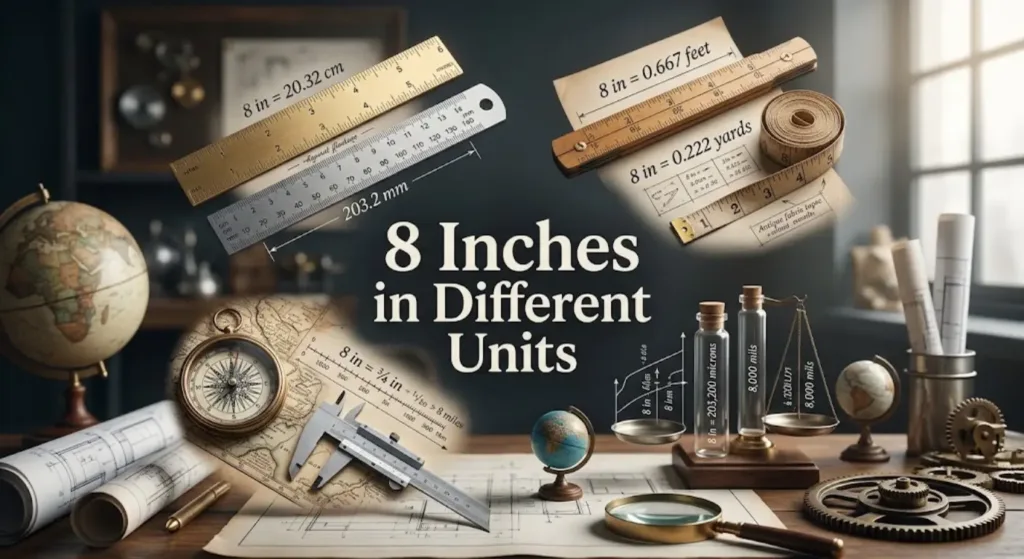
Numbers make more sense side by side. Here’s this physical dimension converted into every unit you’re likely to run into:
| Unit | Value |
|---|---|
| Centimeters | 20.32 cm |
| Millimeters | 203.2 mm |
| Feet | 0.667 ft |
| Yards | 0.222 yd |
| Meters | 0.2032 m |
If you only remember one conversion, make it this one: 8 inches ≈ 20 cm. It’s close enough for almost any real-world estimate, and it’s easy to keep in your head.
Everyday Objects That Are 8 Inches Long
Numbers fade fast. Objects stick. Picture a chef’s knife lying next to an unsharpened pencil, that’s the moment 8 inches stops being an abstract figure and starts being something you can actually see. Here’s the length broken down by where you’re most likely to run into it.
Kitchen & Cooking
Open a kitchen drawer and you’re probably already holding an 8-inch object without realizing it.
Most standard chef’s knives, including well-known lines from Wüsthof and Victorinox, use an 8-inch blade as their default size. It’s considered the sweet spot between control and cutting power. A compact skillet for eggs or a single serving typically measures around 8 inches across. A single dinner fork falls a little short on its own, but two forks laid tip to tip roughly bracket the true size.
Tech & Gadgets
Reach for your tablet, and there’s a decent chance the screen is telling you the answer already.
Devices like the Fire HD 8 are literally named for this screen size, measured diagonally. Compact smart speakers follow a similar pattern. Many cylindrical or boxy models stand close to 8 inches tall, part of why they fit so neatly on a shelf or nightstand.
Stationery & Desk Items
You don’t even need to get up.
A brand-new, unused pencil is almost exactly 8 inches long, making it one of the easiest objects to grab without leaving your desk. The shorter edge of a standard sheet of paper lands close to this length too, handy if you’re estimating something flat, like fabric, tile, or a photo print.
Nature & Food
Even your fruit bowl can double as a measuring tool.
A medium-to-large banana isn’t a precise standard by any means, but it’s a solid gut-check size reference most people already have in the kitchen.
Body & Hand References
Your own body is the most portable comparison point of all.
For many adults, the distance from thumb tip to pinky tip when the hand is fully spread lands somewhere close to 8 inches. It won’t be exact for everyone. But once you measure your own hand span with a ruler one time, you carry a built-in benchmark with you permanently.
How to Measure 8 Inches Without a Ruler
You don’t always have a tape measure handy. These two methods get you a reliable estimate in seconds.
The Hand-Span Method
- Spread your hand as wide as it will comfortably go, thumb to pinky.
- Measure that span once with an actual ruler and write the number down.
- From then on, use your own hand as a portable, personalized 8-inch (or close to it) gauge, no tools required.
This only takes thirty seconds to set up, and it’s genuinely useful for the rest of your life, not just for this one measurement.
Using Everyday Objects as a Backup Method
If you don’t want to measure your hand, keep this shortcut in mind: two standard credit cards laid end to end, plus a thumb’s width, gets you almost exactly to 8 inches. Since most people have a card within reach, it’s a fast, low-effort backup.
8 Inches vs. Other Common Sizes
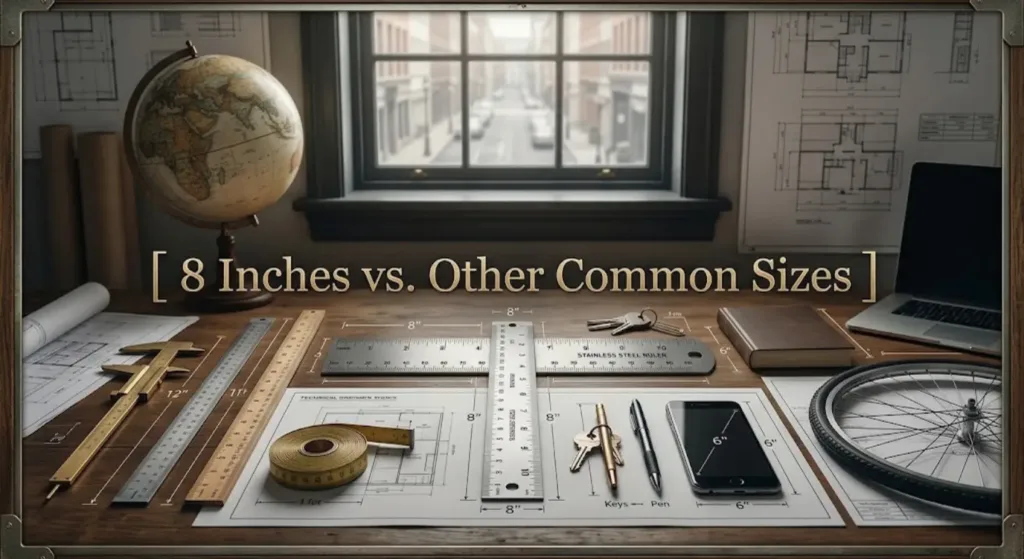
Seeing 8 inches next to its neighbors, a simple visual size guide in table form, makes the size click faster than looking at it in isolation. Sibling guides for each of these are linked below if you want to explore a specific size further.
| Length | In CM | Quick Reference |
|---|---|---|
| 6 inches | 15.24 cm | A standard smartphone, roughly |
| 7 inches | 17.78 cm | A small tablet or large smartphone |
| 8 inches | 20.32 cm | A chef’s knife blade or pencil |
| 10 inches | 25.4 cm | A standard dinner plate |
| 12 inches (1 ft) | 30.48 cm | A standard ruler, full length |
The jump from 6 to 8 inches is more noticeable than it sounds, it’s the difference between something that fits easily in one hand and something that starts to need a bit more room. Want the same visual breakdown for a different length? Check the full inches comparison guide for quick conversions across every common size.
Buying Something Listed as “8 Inches”? What to Check
Still just curious rather than shopping? Feel free to skip ahead to the FAQ. But if you landed here because of a real listing, a knife, a tablet, a laptop sleeve, a planter, here’s what experienced shoppers double-check before trusting a number on a page.
Quick shopper checklist:
- Confirm which dimension the “8 inches” refers to, look for a diagram in the listing, not just the text.
- Compare it mentally against an object from the list above that matches the product type, a knife against a knife, a screen against a screen.
- When in doubt, message the seller and ask directly which edge or dimension was measured.
- If it’s a screen, remember the diagonal will always look bigger on paper than the actual width feels in your hand.
Myth vs. Fact
Myth: “8 inches” always refers to the same kind of measurement, no matter the product.
Fact: It depends entirely on context, diagonal for screens, blade-only for knives, and often unspecified for boxes or containers. Always check which dimension is being described before assuming.
FAQs
Is 8 inches big or small?
It’s a mid-range length, bigger than a smartphone, smaller than a dinner plate. Not small enough to overlook, not large enough to be unwieldy.
How many cm is 8 inches?
8 inches equals 20.32 centimeters, or just over 20 cm if you’re estimating.
What household item is exactly 8 inches?
An unsharpened pencil and a standard chef’s knife blade are two of the most reliable, widely available examples of this actual size.
Is 8 inches a foot?
No. A foot is 12 inches, so 8 inches is two-thirds of a foot, noticeably shorter than a full foot but longer than half.
How can I check 8 inches without a tape measure?
Use your stretched hand span (measured once against a ruler) or lay two credit cards end to end with a thumb’s width added, both get you close enough for everyday purposes.
Conclusion
Eight inches equals 20.32 cm, 0.67 feet, or roughly the length of a chef’s knife blade or an unsharpened pencil. It sits comfortably between a smartphone and a dinner plate, big enough to notice, small enough to hold.
All measurements and object comparisons in this guide were cross-checked against standard manufacturer specifications and the NIST conversion standard. Next time you see “8 inches” on a listing or a recipe, you won’t need to picture a number. You’ll picture the knife in your kitchen drawer.