Pick up a number like “20 kilograms” and it means almost nothing on its own. So how heavy is 20kg, really? Is that light enough to carry up three flights of stairs? Too heavy for your carry-on?
Numbers on a scale don’t tell you how something actually feels in your hands. This guide part of our full library of weight and size comparisons at SizeFactsHub fixes that. You’ll get the exact conversion, a set of real, relatable comparisons, and a few safety tips so you know exactly what you’re dealing with before you lift.
Quick Answer: How Heavy Is 20kg?
20 kilograms equals 44.09 pounds (44 lbs). It’s also equal to 3.15 stone, 705.48 ounces, and 20,000 grams.
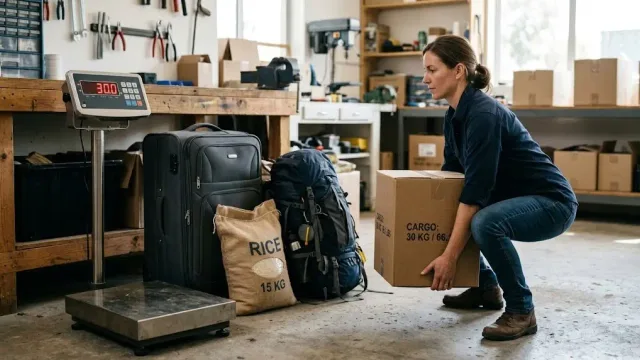
Picture two full 10-liter water jugs held together, or a fully packed carry-on suitcase. That’s 20kg. For context, it’s roughly the weight of a medium-sized dog, a suitcase at many airlines’ checked-baggage limit, or a standard Olympic gym plate. Most healthy adults can lift 20kg off the ground without much trouble, but carrying it any real distance takes genuine effort, your arms, shoulders, and lower back will feel it after a few minutes.
Is 20kg Heavy? The Honest Answer

There’s no single answer to how heavy 20kg is, because “heavy” depends entirely on who’s asking and what they’re doing with it.
For a fit adult doing a short lift, picking a box up off the floor and setting it on a table, 20kg is workable. For that same adult carrying it up a flight of stairs, or holding it away from their body, it starts to feel significantly heavier. And for a child, an older adult, or someone with a back injury, 20kg can be genuinely difficult and even risky to handle without help.
It Depends on Who’s Lifting It
- Healthy adults: Doable for short lifts and carries; tiring over distance or time.
- Gym beginners: 20kg is a meaningful, noticeable weight, often close to a first working set on a barbell.
- Older adults or those with back issues: Can be strenuous or unsafe without proper technique or assistance.
- Children: Should generally not lift 20kg unsupervised, it exceeds safe lifting guidelines for most kids.
How 20kg Compares to Other Common Weights
| Weight | How it compares to 20kg |
|---|---|
| 10kg | Half the weight, easily lifted and carried by most adults |
| 15kg | Noticeably lighter; a common “starter” gym plate weight |
| 20kg | Baseline, moderately heavy for most people |
| 25kg | About 25% heavier; starts to strain grip and lower back on longer carries |
| 30kg | Nearly 50% heavier; typically requires proper lifting form or a second person |
20kg Conversion Chart
If you’re converting for shipping, travel, fitness, or just curiosity, here’s how heavy 20kg is in every unit you might need.
20kg to Pounds, Stone, Ounces & Newtons
| Unit | Value |
|---|---|
| Pounds (lbs) | 44.09 lbs |
| Stone | 3.15 stone |
| Ounces (oz) | 705.48 oz |
| Grams (g) | 20,000 g |
| Force (Newtons, on Earth) | ≈196.2 N |
Quick Formula: How to Convert Kg to Lbs Yourself
You don’t need a calculator every time. Use this simple formula:
kilograms × 2.20462 = pounds
So for 20kg: 20 × 2.20462 = 44.09 lbs.
If you just want a fast mental estimate, doubling the kilogram figure and adding 10% gets you close: 20 × 2 = 40, plus 10% (4) = 44. It’s not exact, but it’s close enough for everyday use. For other weights, our kg to lbs converter does the math instantly.
What Does 20kg Actually Feel Like to Carry?
This is where most weight conversions fall short, a number doesn’t capture the physical experience. Two objects that both weigh exactly 20kg can feel completely different in your hands.
Why Shape and Grip Change How Heavy It Feels
A 20kg gym plate is compact and has a defined edge to grip, so your muscles can engage efficiently. A 20kg suitcase, by contrast, is bulky and awkward, forcing your arm out at an angle and putting more strain on your shoulder and lower back, even though the actual mass is identical.
This is why a 20kg dumbbell can feel manageable while a 20kg box of loosely packed books feels much harder to control. Weight distribution matters as much as the number on the label.
Carrying 20kg vs. Lifting It Off the Ground
Lifting 20kg once, briefly, from the floor to a table uses short bursts of strength and is relatively low-risk for most healthy adults. It’s over in a second or two, so fatigue isn’t really a factor.
Carrying 20kg is a different kind of effort entirely. Holding it for an extended period while walking fatigues your grip, shoulders, and core in a way a single lift never will, and it’s the scenario most likely to cause strain if your posture slips even slightly. According to OSHA’s materials-handling guidance, keeping a load close to your body and within your “power zone” roughly between mid-thigh and mid-chest height makes the biggest difference in how sustainable a carry actually feels, regardless of the object’s weight.
Things That Weigh 20kg By Situation

Rather than one long, generic list, here’s how heavy 20kg is depending on why you’re asking traveler, gym beginner, parent, or just around the house.
For Travelers
- A fully packed carry-on or medium checked suitcase
- The standard checked baggage limit for many international economy tickets (commonly 20–23kg)
- A large duffel bag packed for a week-long trip
Tip: If your airline’s limit is 20kg, pack light electronics and shoes first, they add weight fast without taking up much space. See our airline baggage weight limits guide for allowances by carrier.
For Gym Beginners
- One standard Olympic barbell plate (20kg / 44 lbs)
- An empty Olympic men’s barbell, also 20kg by official International Weightlifting Federation specification, which many US gyms round up to “45 lbs” on the label
- A moderate first working set on a leg press or deadlift for a beginner
Tip: If you’re new to lifting, treat 20kg as a serious working weight, not a warm-up. Our beginner’s guide to barbell training walks through safe progression.
For Parents
- The average weight of a healthy 5- to 6-year-old child, based on CDC growth chart data
- A loaded school backpack is nowhere close to this, but it’s a useful benchmark if you’re ever lifting or carrying your child
Tip: If you’re regularly lifting a child around this weight, bend at the knees rather than the waist to protect your lower back.
Around the House
- A medium-sized dog breed, such as a Border Collie or a young Labrador
- A small-to-mid-size microwave
- A twin-size mattress (unboxed)
- A standard bag of cement or two large bags of dog food
How to Lift 20kg Safely
Because 20kg sits right at the point where many people start to feel strain, understanding how heavy 20kg is for your specific situation matters before you lift and it’s worth knowing the basics of safe lifting, especially if you’re moving it repeatedly or over any distance. The steps below follow OSHA’s manual material handling guidelines, which note that four out of five manual-handling injuries affect the lower back.
Proper Lifting Technique
- Get close to the load. Keep it near your body rather than reaching out for it.
- Bend your knees, not your back. Squat down to the object instead of hinging at the waist.
- Keep your back straight and core engaged as you stand up.
- Lift with your legs, using the large muscles in your thighs, not your spine.
- Move your feet, don’t twist. Turning your body while holding weight is a common cause of back strain.
Common Mistakes That Cause Injury
- Bending at the waist instead of the knees
- Holding the object away from your body instead of close to your chest
- Twisting while carrying instead of stepping around
- Lifting too quickly instead of using a controlled motion
- Ignoring pain or fatigue and continuing to carry anyway
When to Ask for Help or Use Equipment
If you’re lifting 20kg repeatedly, over a long distance, up stairs, or if you have any existing back or joint issues, it’s worth using a dolly, trolley, or asking someone to help you carry the load, even though 20kg is technically liftable by most adults on its own. See our guide to lifting heavy objects safely for more detail.
This is general safety guidance, not medical advice. If you have a chronic back condition or a recent injury, check with a doctor or physical therapist before regularly lifting loads this heavy.
Common Questions People Also Ask
Is 20kg heavy for a suitcase?
Yes, it’s near the top of most international airline weight limits and will require real effort to lift into an overhead bin or car trunk. Most travelers find it workable for short distances but tiring to carry far.
Is 20kg heavy for a gym beginner?
Yes, relatively. It’s a legitimate working weight, roughly equivalent to a standard Olympic barbell or one full-size gym plate, not a warm-up weight for someone new to lifting.
What animal weighs about 20kg?
Medium dog breeds land close to this range, including breeds like the Border Collie or a young adult Labrador Retriever.
Is 20kg heavy to carry up stairs?
It can be. Stairs add extra strain compared to carrying on flat ground, since you’re also lifting your own body weight with each step. Take breaks if needed and keep the load close to your body.
How many pounds is 20kg exactly?
20kg equals exactly 44.0924 pounds, commonly rounded to 44.09 lbs. That’s the core number behind how heavy 20kg is in the units most US readers know best.
How heavy is 20kg compared to everyday carrying?
It’s roughly the weight of a fully packed suitcase or a medium-sized dog noticeable, but manageable for most healthy adults over short distances.
Final Thoughts: What 20kg Really Means for You
20kg (44.09 lbs) sits in a middle zone heavy enough to notice, light enough for most healthy adults to manage for short lifts. The real answer to “how heavy is 20kg” depends on the shape of what you’re lifting, how far you’re carrying it, and your own physical condition.
Whether you’re packing a suitcase, starting a gym routine, or just curious how your dog stacks up on the scale, the numbers above give you a solid, accurate reference point, and the lifting tips above will help you handle it safely when it counts.