Last updated: August 2026 · Figures checked against NIST and BIPM standards.
Quick Answer
40 kg = 88.18 lbs.
How Much Is 40kg? 40 kg = 88.18 lbs. That’s the full answer: 40 kilograms equals 88.18 pounds, or approximately 6.3 stone.
For the reverse direction: 1 lb = 0.45359237 kg, so if you ever need to go from pounds back to kilograms, that’s the number to multiply by.
If you’ve ever stared at a shipping label, a gym plate, or a luggage scale and wondered what that number actually means, stick around. This guide covers the exact conversion, the easy shortcut for doing it in your head, what 40kg looks like in real life, and how it compares to typical airline baggage limits if that’s what brought you here.
How to Convert 40kg to Pounds (The Formula)

Converting kilograms to pounds isn’t complicated once you know the trick. There’s a precise version for accuracy and a rough version for speed, and knowing when to use each one matters more than most people realize.
The Precise Formula
One kilogram equals exactly 2.2046226218 pounds. This isn’t an approximation, it’s fixed by international agreement, so it works every time, for any weight.
To convert kilograms to pounds:
Pounds = Kilograms × 2.2046226218
For 40kg:
40 × 2.2046226218 = 88.184904874 lbs
Rounded to two decimal places, that’s 88.18 lbs.
The Quick Mental-Math Shortcut
Carrying ten decimal places around in your head isn’t realistic, and honestly, you don’t need to. For everyday situations, round the conversion factor to 2.2.
Pounds ≈ Kilograms × 2.2
For 40kg: 40 × 2.2 = 88 lbs
That’s close enough for packing a suitcase, estimating a gym weight, or guessing a friend’s dog’s weight. The gap between 88 and 88.18 is less than a quarter of a pound, nobody’s noticing that difference outside of a lab or a customs form.
A Different Scenario: Converting a Number That Isn’t Round
The math above is easy because 40 is a clean number. Real life rarely is, so here’s how the same formula handles something messier, say, a checked bag that weighs 38.6kg on the airport scale.
38.6 × 2.2046226218 = 85.1 lbs
Same formula, same two steps, multiply, then round. Once you’re comfortable with 40kg, any other number on the scale works exactly the same way.
40kg in Other Units (Stone, Ounces, Grams, and 40 kg to Lbs Recap)
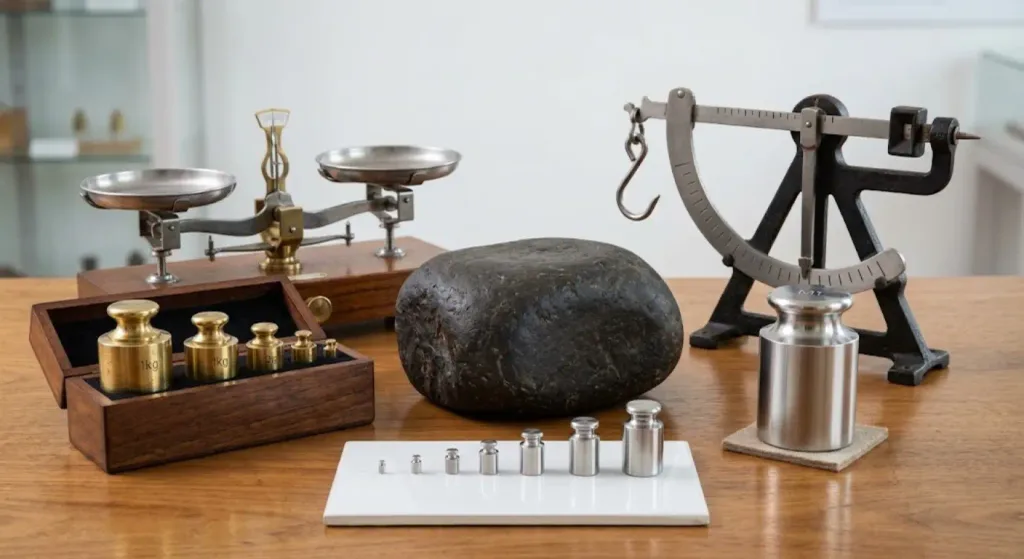
Pounds aren’t the only unit people search for. Depending on where you live or what you’re measuring, you might want 40kg expressed in stone, ounces, or grams, or you might have landed here searching specifically for 40 kg to lbs, which, to recap, is 88.18 lbs.
How Much Is 40kg in Stone?
In the UK, body weight is commonly measured in stone rather than pounds. One stone equals 14 pounds, so:
88.18 lbs ÷ 14 = 6.3 stone
So 40kg comes out to 6 stone, 4 pounds, useful if you’re comparing a weight reading against a UK bathroom scale or a British recipe reference.
How Much Is 40kg in Ounces?
Since 1 pound equals 16 ounces:
88.18 lbs × 16 = 1,410.96 ounces
This unit matters most for smaller, precise measurements, think shipping labels, postal weight limits, or ingredient conversions, rather than something you’d use for body weight.
How Much Is 40kg in Grams?
This one’s simpler because it stays within the metric system:
1 kilogram = 1,000 grams, so 40kg = 40,000 grams.
40kg to Lbs: Nearby Weight Conversion Table
If you’re checking 40kg but might actually need a nearby value, this table saves you a second search.
| Kilograms (kg) | Pounds (lbs) | Stone |
|---|---|---|
| 30 kg | 66.14 lbs | 4.7 st |
| 32 kg | 70.55 lbs | 5.0 st |
| 34 kg | 74.96 lbs | 5.4 st |
| 36 kg | 79.37 lbs | 5.7 st |
| 38 kg | 83.78 lbs | 6.0 st |
| 40 kg | 88.18 lbs | 6.3 st |
| 42 kg | 92.59 lbs | 6.6 st |
| 44 kg | 97.00 lbs | 6.9 st |
| 45 kg | 99.21 lbs | 7.1 st |
| 50 kg | 110.23 lbs | 7.9 st |
Tip: bookmark this table if you regularly convert weights in this range, it covers most everyday reference points without needing a separate lookup each time.
What Does 40kg Actually Look Like?
Numbers on a page don’t always mean much until you connect them to something familiar. Here’s what 40kg (88 lbs) is in the neighborhood of, out in the real world.
Everyday Objects That Weigh About 40kg
- A large, fully-loaded suitcase at the upper end of many airline weight limits
- A mid-size washing machine
- Two full kegs of beer, combined
- A large bag of concrete mix (roughly one standard bag)
- An adult mountain bike plus a full set of gear
For a lighter comparison, see our guide on how heavy 10kg is to see what 10kg feels like in everyday life.
Animals That Weigh Around 40kg
- A large adult Rottweiler or Mastiff-mix dog
- A newborn giraffe (yes, really, they’re born tall, not heavy)
- A small adult female kangaroo
- A large domestic pig at a mid-growth stage
These comparisons aren’t precise science, they’re meant to make an abstract number feel tangible, especially if pounds and kilograms both feel equally foreign to you.
How Much Is 40kg in Everyday Situations

Airline Baggage and Travel
Checked baggage limits are set individually by each airline, and most commonly-cited economy allowances fall somewhere in the 20–32kg range per bag. At 40kg, a single bag would exceed the vast majority of standard allowances and would likely trigger an overweight baggage fee. Before you fly, check your specific airline’s published baggage policy, the number changes by carrier, route, and even ticket class, so there’s no single universal limit to rely on.
Gym Weights and Fitness
In strength training, 40kg (about 88 lbs) is a common reference point on the way toward intermediate lifts like the deadlift or barbell squat. What actually counts as “heavy,” though, comes down to the individual, training experience, body weight, and goals all shape that answer, so treat this as a general landmark rather than a target everyone should be hitting. One practical note: if you’re loading a barbell, remember to add the bar’s own weight (commonly 20kg) on top of the plates.
Body Weight Context
For human body weight, 40kg (88 lbs) sits on the lower end of the healthy adult range and shows up more often in children, some adolescents, or smaller-framed adults. Because healthy weight depends on height, age, sex, and a range of individual health factors, a single number like this one can’t tell the whole story on its own. Anyone tracking body weight for health reasons is better served talking to a doctor or registered dietitian, who can interpret what a specific weight means for their situation, not a general conversion guide like this one.
Common Mistakes When Converting Kg to Lbs
The math itself is simple, but a few small slip-ups are responsible for most conversion errors people run into. Here’s what to watch for:
- Rounding too early and repeating the error. Rounding 2.2046 down to 2 instead of 2.2 introduces a bigger error than most people expect over larger weights.
- Confusing stone with pounds. Stone and pounds are related but different units, 6.3 stone is not 6.3 pounds, and mixing them up leads to significant misreads on body weight.
- Forgetting that ounces here mean weight, not volume. A fluid ounce (volume) and a weight ounce are different measurements, don’t cross-reference recipe ounces with body weight ounces.
- Assuming all pounds are the same. The avoirdupois pound (used for body weight and general goods) differs slightly from other historical “pound” units. Nearly everyone means avoirdupois today, but it’s worth knowing the term exists.
- Ignoring the bar or container weight. When converting gym plates or shipping weights, people sometimes forget to add or subtract the weight of the barbell, box, or packaging itself.
Kilograms vs. Pounds: Why Two Systems Exist
It’s a fair question, why do we even have two different weight systems in the first place?
What Is a Kilogram?
The kilogram is the base unit of mass in the International System of Units (SI), the metric system used by nearly every country in the world for scientific, medical, and everyday measurement. It was historically defined by a physical platinum-iridium cylinder held at the International Bureau of Weights and Measures (BIPM) in France, though today it’s defined using a fundamental physical constant for greater precision.
What Is a Pound?
The pound is a unit of mass used mainly in the United States and, to a lesser extent, the United Kingdom, where it exists alongside stone for body weight. The modern international avoirdupois pound was formally standardized in 1959 through an agreement between the US and Commonwealth nations, fixing it at exactly 0.45359237 kilograms, a figure maintained today by standards bodies like the National Institute of Standards and Technology (NIST).
The short version: most of the world uses kilograms because it’s the global scientific and metric standard, while the US continues to use pounds as part of its customary measurement system. Neither is “more accurate”, they’re just different standards that happen to coexist, which is exactly why conversion tools like this one are useful.
FAQs
How much is 40 kg in pounds?
40kg equals 88.18 pounds. Using the precise conversion factor (2.2046226218), the exact figure is 88.184904874 lbs, typically rounded to two decimal places for everyday use.
How much is 40kg in stone?
40kg is approximately 6.3 stone, or 6 stone and 4 pounds when broken into the traditional stone-and-pounds format used in the UK.
Is 40kg a lot to lift?
It depends on context and individual training level. For an experienced lifter, 40kg on a barbell lift may feel light, while for a beginner, or when lifting any object without proper form, it can be genuinely heavy and worth approaching carefully.
What things weigh 40kg?
Common real-world comparisons include a large loaded suitcase, a mid-size washing machine, a large adult dog breed, or roughly two kegs of beer combined.
How do you convert kg to lbs manually?
Multiply the kilogram figure by 2.2046226218 for a precise result, or by 2.2 for a fast, close-enough estimate. For 40kg, that’s 40 × 2.2046226218 = 88.18 lbs precisely, or 40 × 2.2 = 88 lbs as a quick estimate.
Conclusion: How Much Is 40kg?
So, how much is 40kg? 88.18 pounds, or about 6.3 stone, a number you can get to instantly using the formula kg × 2.2046226218, or with kg × 2.2 for a fast everyday estimate.
Beyond the raw number, 40kg shows up in real life more often than you’d think: it’s near the upper edge of many airline baggage allowances, a familiar strength-training landmark, and in the same range as a large dog or a fully loaded suitcase. Whether you’re packing for a flight, reading a gym plate, or just satisfying curiosity about a number you saw somewhere, you now have both the exact answer and the context to make sense of it.