How heavy is 10kg? Ever tried to picture 10 kilograms and drawn a total blank? You’re not alone. Kilograms are easy to write down and hard to feel, especially if you grew up thinking in pounds, or you’ve simply never had a reason to know what 10kg feels like in your hands.
Maybe you’re packing a suitcase and trying to stay under a weight limit. Maybe you’re eyeing a 10kg dumbbell at the gym and wondering if you should start lighter. Or maybe a courier just quoted you a 10kg parcel fee and you want to know if that’s actually a lot.
Whatever brought you here, by the end of this guide you’ll know exactly how heavy 10kg is, what it compares to in real life, and whether it counts as “heavy” for your specific situation.
How Heavy Is 10kg? Quick Answer
If you’re wondering how heavy is 10kg, the answer is 22.05 pounds (about 22 lbs), or 10,000 grams. For a quick mental picture: it’s roughly the weight of a large bag of potatoes, two average house cats, or a small suitcase packed for a weekend trip. Most healthy adults can lift 10kg comfortably, though carrying it for a long distance will tire you out faster than you’d expect.
That’s the short version. Here’s the fuller picture.
What Is a Kilogram, Exactly?
Definition: A kilogram (kg) is the base unit of mass in the metric system, equal to 1,000 grams. It’s the standard unit used to measure weight in nearly every country in the world.
A kilogram is the base unit of mass in the metric system, the system used by nearly every country in the world except the United States, Liberia, and Myanmar. When people ask “how heavy is 10kg,” they’re really asking how much mass 10 of these units add up to.
Where the Kilogram Comes From
For over a century, one kilogram was defined by a physical platinum-iridium cylinder locked away in a vault in France. That changed in 2019, when the world’s scientific community redefined the kilogram using a fixed physical constant (Planck’s constant) instead of a physical object, as documented by the International Bureau of Weights and Measures (BIPM). You don’t need the physics to use the number, just know that the kilogram is now one of the most precisely defined units of measurement on Earth, which is part of why it’s trusted globally for everything from grocery scales to scientific research. The U.S. National Institute of Standards and Technology (NIST) has a helpful plain-language explainer if you want to go deeper.
How Heavy Is 10kg in Pounds and Grams?
If kilograms aren’t your default unit, converting to something familiar makes the number click faster.
10kg to Pounds
10 kilograms equals 22.05 pounds. If you want a simple mental shortcut, just double the kilogram number and add a little extra, 10kg doubled is 20, plus about 2 more, gets you close to 22 pounds.
10kg to Grams and Ounces
10 kilograms is exactly 10,000 grams, or about 352.7 ounces. This is useful context if you’re comparing it to something you’d normally measure in grams, like food packaging or a kitchen scale reading.
Unit
Value
Kilograms
10 kg
Pounds
22.05 lbs
Grams
10,000 g
Ounces
352.7 oz
Stone (UK)
1.57 stone
What Does 10kg Actually Feel Like?
Numbers only take you so far. Here’s the honest, physical answer: 10kg feels manageable to pick up once, but it makes itself known quickly if you’re carrying it any distance. Think about the difference between lifting a bag of dog food off a shelf versus walking three blocks with it, the weight doesn’t change, but your experience of it does. That’s the gap most weight guides skip, and it’s the real answer to “is 10kg heavy.”
10 Everyday Things That Weigh 10kg
Numbers are abstract. Objects aren’t. Here’s what weighs 10kg in real life, grouped by where you’re most likely to encounter it.
Around the House
A large bag of potatoes or rice, most 20-pound bags sold at grocery stores land almost exactly at 10kg.
A full laundry load (clothes plus water absorbed), roughly in the same range once everything’s wet.
Two gallons of paint, a single gallon is about 5kg, so two cans together match 10kg closely.
At the Gym
A 10kg dumbbell or kettlebell, a common entry point in strength training, heavy enough to build strength safely without overloading beginners. Adjustable sets like the Bowflex SelectTech 552 and fixed cast-iron sets like CAP Barbell hex dumbbells both include a 10kg (22 lb) setting, which is why it’s such a widely recognized reference weight at the gym.
Two 5kg dumbbells held together, one in each hand, a more balanced way to feel the same total weight.
While Traveling
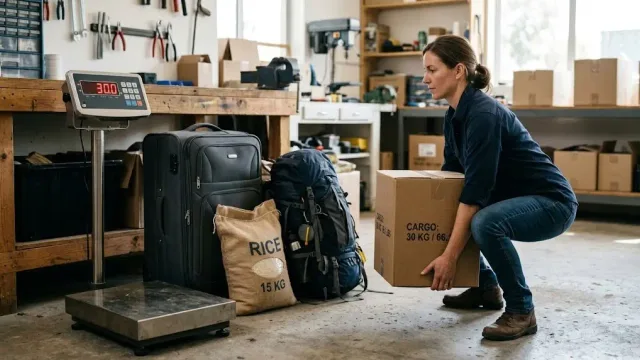
A packed carry-on suitcase, most airlines set cabin baggage limits at or near 10kg, which is exactly why this comparison matters to travelers. See our guide on airline carry-on weight limits for specific airline policies.
A weekend’s worth of clothes and toiletries in a mid-sized bag.
With Pets and Kids
A medium-sized dog breed, such as a Beagle or Cocker Spaniel, typically weighs close to 10kg.
A large bag of dry dog food, the standard size sold for medium and large dogs.
A healthy toddler around age 1–2, parents often describe this stage as “surprisingly heavy” to carry for long periods, which lines up with the 10kg comparison closely.
Comparison Table, 10kg at a Glance
Item
Approximate Weight
Matches 10kg?
Bag of potatoes
~10 kg
Yes
10kg dumbbell
10 kg
Exact
Medium dog (e.g., Beagle)
9–11 kg
Close
Packed carry-on suitcase
8–10 kg
Close
Toddler (1–2 years old)
9–13 kg
Close
Two gallons of paint
~10 kg
Yes
Bowling ball (x2)
~10 kg
Close
Is 10kg Heavy? It Depends on the Context
So, how heavy is 10kg in practical terms? This is where most guides stop short. “Heavy” isn’t one fixed thing; it depends entirely on what you’re doing with the weight.
Is 10kg Heavy to Lift?
For most healthy adults, lifting 10kg once, say, picking up a bag off the floor, is easy. It becomes noticeably more demanding if you’re lifting it repeatedly, holding it overhead, or carrying it any real distance. If you’re building strength gradually, a beginner-friendly dumbbell weight like 10kg is a common, sensible starting point.
Is 10kg Heavy for Luggage?
Many international airlines cap cabin (carry-on) baggage at around 10kg, which is exactly why this is one of the most common real-world reasons people search this question. If you’re near that limit, every extra item matters, a good reason to weigh your bag before you leave for the airport rather than finding out at check-in. Airlines that advertise a 10kg limit often re-weigh bags at the boarding gate, not just at check-in, so it genuinely pays to double-check at home first. For help staying under the limit, see our guide on packing a suitcase without overpacking.
Is 10kg Heavy for a Parcel or Shipment?
For most courier and postal services, 10kg sits in the “standard” range, heavier than a typical letter or small box, but well within what a single person can carry from a doorstep. It’s rarely considered an oversized or specialty shipment.
Is 10kg Heavy for a Dog or Toddler?
For a dog, it depends entirely on the breed. For a small breed, 10kg would be overweight and worth discussing with a vet. For a medium breed like a Beagle or Cocker Spaniel, 10kg is right in the normal, healthy range.
For a toddler, 10kg is a completely typical weight for a one- to two-year-old, but it can still feel unexpectedly heavy to carry for long stretches, especially on one hip, or up and down stairs. Many parents find that a well-fitted carrier redistributes the weight more comfortably than carrying a toddler in-arms for extended periods.
Weight vs. Density: Why 10kg Doesn’t Always Feel the Same
Here’s a detail most comparisons miss: two objects that both weigh 10kg can feel completely different to carry. Take the dumbbell and the suitcase from earlier, both weigh close to 10kg, but they don’t feel the same in your hands. A standard Pokémon card weighs only about 1.8 grams, despite having precisely defined dimensions.
Dense object (e.g., 10kg dumbbell)
Bulky object (e.g., 10kg packed suitcase)
Shape
Compact, close to your body
Spread out, awkward to grip
Balance
Easy to control
Harder to keep steady
Perceived effort
Feels manageable
Feels heavier than the number suggests
The mass is identical in both cases 10kg is 10kg, but your body has to work harder to balance and hold the bulkier, less compact object. When you’re estimating “is this heavy,” think about both the number and the shape of what you’re lifting.
A Quick Note on Lifting 10kg Safely
Even though 10kg is a moderate weight, lifting technique matters more than the number itself. General safe-lifting guidance from occupational health organizations, including the U.S. Occupational Safety and Health Administration (OSHA), recommends bending at the knees rather than the waist, keeping the object close to your body, and avoiding twisting your spine while carrying a load. This applies just as much to a 10kg suitcase as it does to a 10kg gym weight or a squirming toddler. If you’re lifting 10kg regularly as part of work or exercise, and you experience ongoing discomfort, it’s worth checking in with a doctor or a qualified trainer rather than pushing through it, repetitive strain at “moderate” weights is a common, avoidable injury pattern.
Common Mistakes People Make About 10kg
Assuming all 10kg objects feel the same, density and shape change how heavy something feels, even at an identical weight, so a suitcase and a dumbbell of the same mass demand very different effort to carry.
Forgetting to weigh luggage before leaving home, airport scales are unforgiving, and overage fees add up fast, sometimes costing more than checking a second bag would have.
Confusing kilograms and pounds when shopping internationally, a “10kg” product listing is not the same number as “10 lbs” (10 lbs is under 4.6kg), and mixing them up leads to ordering the wrong size or underestimating a shipping charge.
Ignoring lifting posture because the weight “isn’t that heavy”, repetitive strain builds up even at moderate weights like 10kg, especially with poor form over many repetitions.
FAQs
Is 10kg heavy or light? 10kg is a moderate weight, noticeably heavier than a light grocery bag, but well within what most healthy adults can lift and carry without strain for short periods. It only starts to feel genuinely heavy once you’re carrying it a long way or lifting it over and over.
What is an example of 10 kilograms? A large bag of potatoes, a 10kg dumbbell, or a medium-sized dog breed like a Beagle are all common real-world examples of 10kg, pretty much anything you’d describe as “a solid armful.”
How many pounds is 10kg? 10kg equals22.05 pounds, you can round it to “about 22 lbs” for everyday purposes.
Is 10kg a lot for hand luggage? It’s right around the typical cabin baggage limit for many airlines, so it’s worth checking your specific airline’s policy and weighing your bag at home before you travel, since gate staff often re-weigh bags at boarding.
How heavy is 10kg for a dog? It’s a healthy weight for many medium dog breeds, but could indicate being overweight for a small breed, a vet can confirm what’s right for your specific dog’s size and body condition.
What does 10kg feel like to lift? Manageable to lift once, but tiring to carry over distance or lift repeatedly, similar to carrying a full bag of dog food, a packed weekend suitcase, or a one-year-old toddler on your hip.
Related Weight Comparisons
Curious how other common weights compare? See how heavy 5kg feels (about half this weight, closer to a bag of flour or a small housecat), 15kg (a checked-bag territory weight, or a large dog breed), or 20kg (double today’s number, think airline checked-baggage limits or a loaded travel backpack).
Conclusion: How Heavy Is 10kg?
10kg equals 22.05 pounds, or 10,000 grams, about the weight of a bag of potatoes, a medium-sized dog, or a packed carry-on suitcase. Whether it counts as “heavy” really depends on what you’re doing with it: lifting once, carrying for a distance, packing for a flight, or comparing it to a pet’s or toddler’s healthy weight. Now that you’ve got a handful of real-world anchors, you’ll never have to guess what 10kg feels like again.
Share Article:
Written by Jon Parker
Contributor
Research writer at SizeFactsHub. Dedicated to providing accurate dimensional data, scale guides, and measurement comparisons.