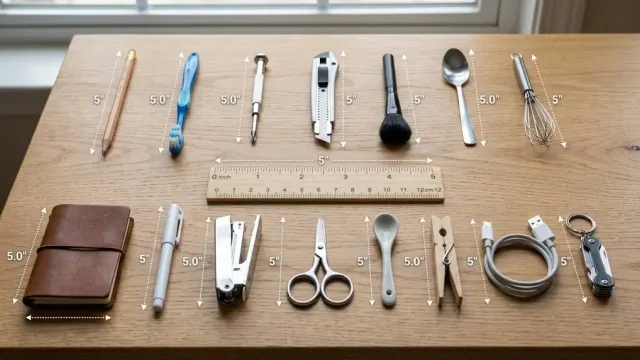
Quick Answer
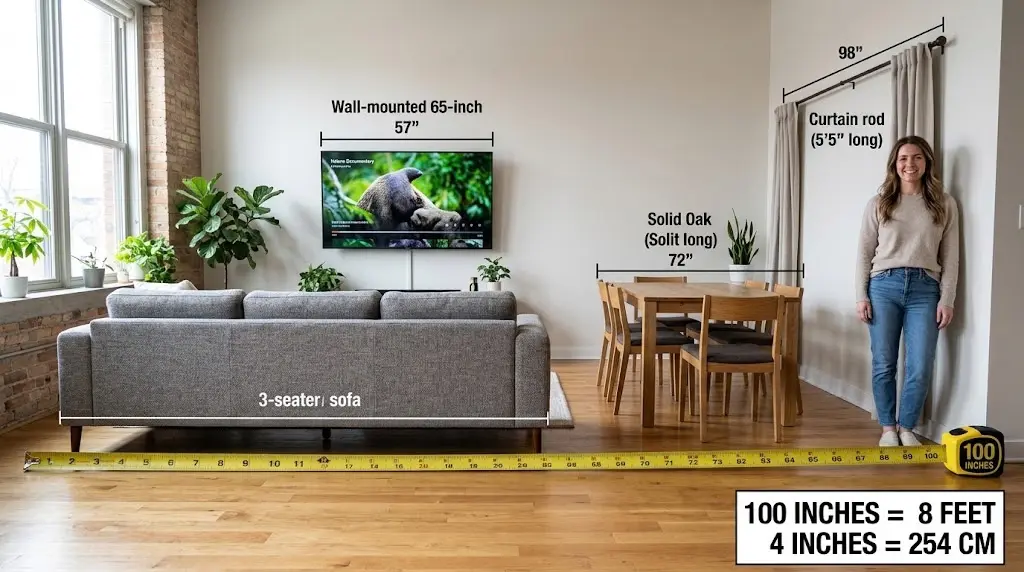
How long is 100 inches? It equals 8.33 feet (8 feet 4 inches), 254 centimeters, 2,540 millimeters, 2.54 meters, or about 2.78 yards.
That’s roughly the length of a large sectional sofa, a king-size bed with its headboard attached, or a regulation pool table. It’s also taller than almost every standard doorway.
If you just needed the number, that’s it. But if you want to actually picture 100 inches, or you’re trying to figure out whether something will fit in your room, your car, or through your front door ,keep reading. This guide breaks down the math, gives you no-tool tricks to estimate it, and walks through real objects that land close to exactly 100 inches long.
What Is an Inch, Exactly?
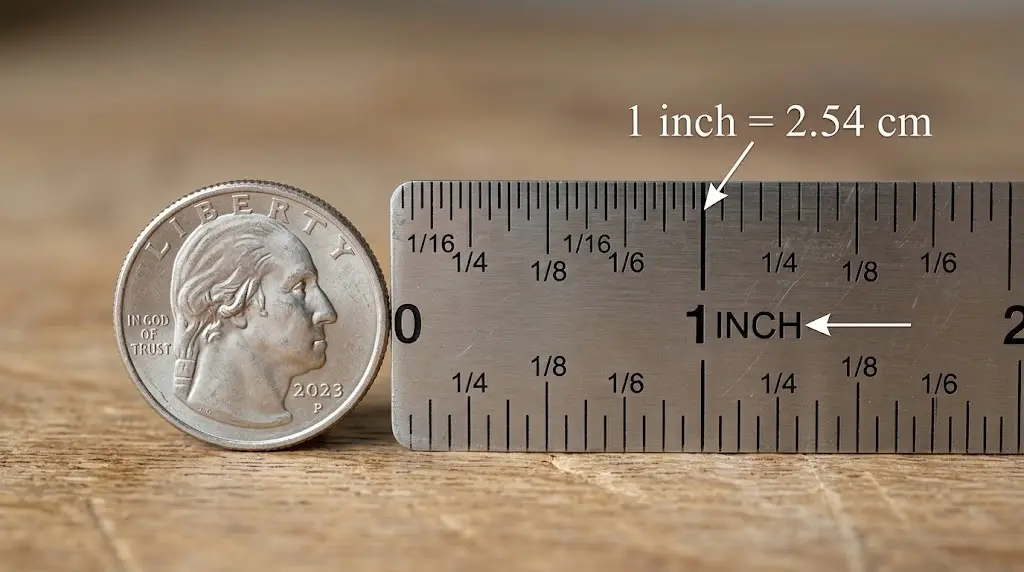
An inch is a unit of length used mainly in the United States, defined as exactly 2.54 centimeters. That definition isn’t a rough estimate, it’s the internationally agreed standard set by the International Yard and Pound Agreement of 1959, which is why inch-to-metric conversions always come out to clean, exact numbers. Understanding this basic unit makes it easier to see how long 100 inches really is in everyday terms.
Where the Inch Comes From
The inch has been used for centuries, but its modern definition was standardized in 1959 through an agreement between the US, UK, and several other countries. Before that, different countries used slightly different inch lengths. Today, one inch is fixed at 2.54 cm everywhere in the world, which is why the same formula for how long 100 inches is works no matter where you are.
Inches vs. Other Units of Length
Inches are part of the imperial (US customary) system, alongside feet, yards, and miles. Twelve inches make one foot, and three feet make one yard. Most of the rest of the world uses the metric system instead, where everything scales in multiples of ten, millimeters, centimeters, meters, and kilometers. That’s why you’ll often see both systems listed side by side in conversion charts, especially for anything sold internationally, like TVs or furniture.
100 Inches Conversion Chart
Here’s every common conversion for how long 100 inches is, so you don’t have to do the math yourself.
| Unit | Value |
| Feet | 8.33 ft |
| Feet + Inches | 8 ft 4 in |
| Centimeters | 254 cm |
| Millimeters | 2,540 mm |
| Meters | 2.54 m |
| Yards | 2.78 yd |
100 inches to feet, specifically: 100 ÷ 12 = 8.33 feet, or 8 feet 4 inches written as feet-and-inches. This is the single most-searched conversion for this measurement, so it’s worth stating plainly on its own.
How 100 Inches Compares to Nearby Sizes
| Length | In Feet | In Centimeters |
| 90 inches | 7.5 ft | 228.6 cm |
| 96 inches | 8 ft | 243.8 cm |
| 100 inches | 8.33 ft | 254 cm |
| 108 inches | 9 ft | 274.3 cm |
| 120 inches | 10 ft | 304.8 cm |
How to Convert 100 Inches Yourself (The Math)
If you ever need to convert a different number of inches,not just 100, these are the formulas to keep handy.
Inches to Feet Formula
Divide the number of inches by 12.
100 ÷ 12 = 8.33 feet, or 8 feet with a remainder of 4 inches (8 ft 4 in).
Inches to Centimeters Formula
Multiply the number of inches by 2.54.
100 × 2.54 = 254 cm.
Inches to Meters Formula
Divide the number of centimeters by 100, or divide inches by 39.37.
254 cm ÷ 100 = 2.54 m.
Expert tip: Once you memorize that 1 inch = 2.54 cm, you can convert almost any measurement in your head with a quick multiplication, no calculator needed.
How to Visualize 100 Inches Without a Tape Measure
Sometimes you just need a rough idea of length and don’t have a measuring tool on hand. These body-based estimates won’t be perfectly precise, but they’re accurate enough for everyday decisions like arranging furniture or checking if something will clear a doorway.
| Method | Average Unit Length | Reps Needed for ~100 Inches |
| Handspan (thumb to pinky, spread) | ~8 inches | 12–13 spans |
| Forearm (elbow to fingertip) | ~16 inches | 6 forearms |
| Arm span (fingertip to fingertip) | ~60–70 inches | 1 full span + about one-third more |
How to use it: Pick whichever method fits the space. Handspans work best for shorter, flat surfaces like a table or shelf. Forearms are faster for medium distances like a wall gap. A single arm span plus a short extra stretch is the quickest way to eyeball something wide, like a sofa’s length across a room.
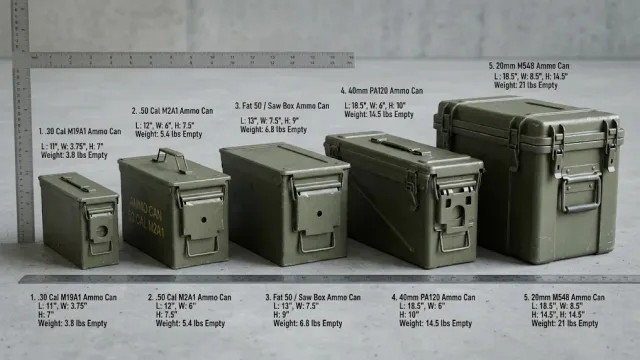
For example, knowing the dimensions of everyday objects, such as an Arizona can, can give you a useful reference point when visualizing measurements.
These tricks are approximations, not replacements for an actual tape measure, but they’re genuinely handy when you’re standing in a furniture showroom without one.
How Big Is a 100-Inch TV?
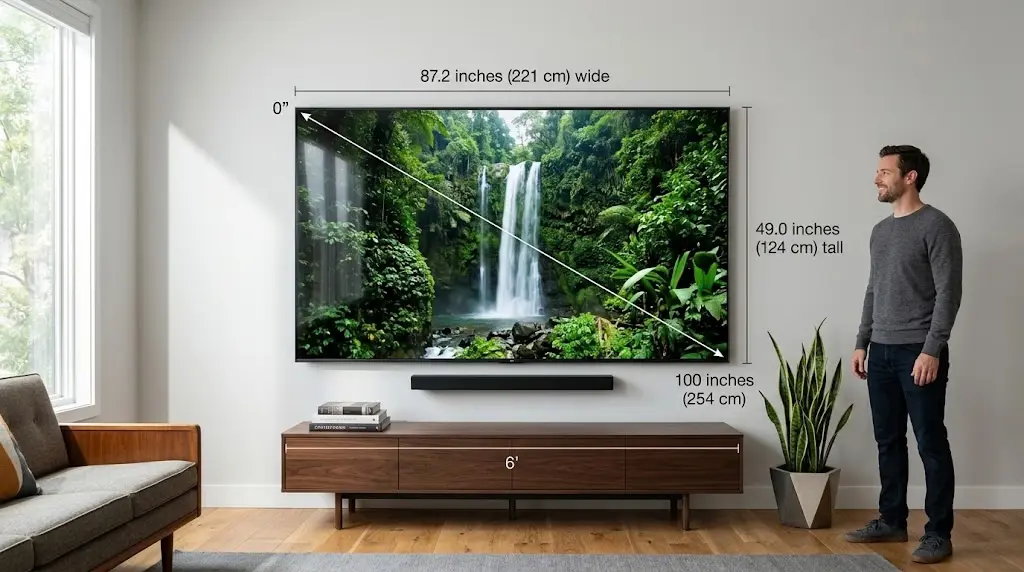
This is one of the most common reasons people ask how long 100 inches is, and it deserves an early, clear explanation, because a “100-inch TV” doesn’t mean the screen is 100 inches wide.
Screen Width and Height Explained
TV sizes are always measured diagonally, corner to corner, not across the width. For a standard 16:9 aspect ratio screen, a 100-inch diagonal works out to roughly 87 inches wide and 49 inches tall (multiply the diagonal by 0.8716 for width and 0.4903 for height). The full TV chassis, including the bezel and stand, typically runs a few inches larger than the screen-only measurement.
Ideal Viewing Distance
According to SMPTE (Society of Motion Picture and Television Engineers) viewing-distance guidelines, a 100-inch screen is best viewed from about 10 to 13 feet away for balanced, comfortable viewing. Sitting closer can feel overwhelming, similar to a front-row movie theater seat; sitting farther reduces the immersive effect the large screen provides.
Wall Space and Stand Requirements
For a wall-mounted setup, most installers recommend at least 96 to 104 inches of clear wall width. For a media console, the stand should extend a few inches beyond the TV’s frame on each side for visual balance and protection from accidental bumps. Given the size and weight of 100-inch panels, furniture rated well above the TV’s actual weight is essential.
12 Everyday Things That Are About 100 Inches Long
Numbers are easier to remember when you can picture them next to something familiar. Here’s a quick-reference table of objects that land close to 100 inches, followed by context on the ones worth knowing more about.
| Object | Approx. Length | Category |
| Large sectional sofa | 95–105 in | Furniture |
| King bed with headboard | ~95–105 in | Furniture |
| Large dining table (8–10 seats) | 96–108 in | Furniture |
| Pool table (playing surface) | 100–102 in | Sports & Recreation |
| Recreational kayak | up to 100 in | Sports & Recreation |
| Basketball hoop pole (base section) | up to 100 in | Sports & Recreation |
| Midsize sedan | ~190 in (100 in ≈ half) | Vehicles |
| Pickup truck bed, tailgate down | ~100 in | Vehicles |
| Single-car garage door | 96–108 in wide | Home |
| Standard interior doorway | 80 in tall (100 in is 20 in taller) | Home |
| Tallest adult humans | 84–87 in | People |
| Standard tape measure | 300 in total (100 in = ⅓ of it) | Tools |
A few of these are worth a closer look, because the “why” is genuinely useful:
Sectional sofas land in this range because manufacturers design the longest run to seat four to five people comfortably, which is exactly why movers and delivery teams always ask for the sofa’s full length before scheduling a drop-off through a standard doorway.
Pool tables aren’t a rough estimate at all, the World Pool-Billiard Association sets exact playing-surface dimensions for competitive play, and home tables built to that spec land right at 100 to 102 inches.
Pickup truck beds hit close to 100 inches specifically with the tailgate down, which is why an 8-foot bed (96 inches) is often marketed as capable of hauling longer furniture and building materials than the closed-bed number suggests.
How to Measure 100 Inches at Home
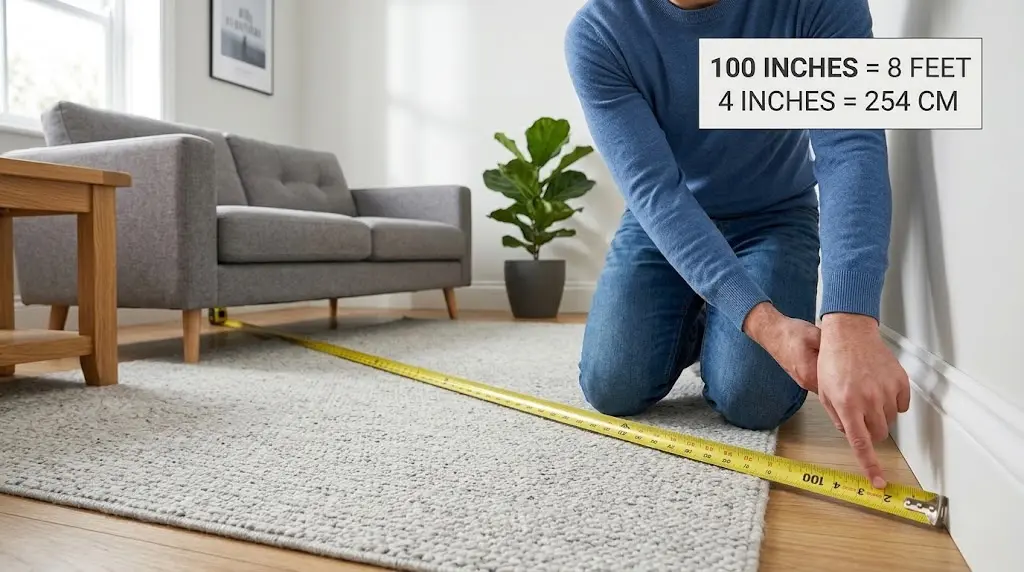
If you need to measure out exactly 100 inches, for furniture placement, a DIY project, or checking clearance, here’s the simplest approach. Whether you’re measuring furniture, a wall, or another large object, knowing how long 100 inches is can help you mark the correct distance before you start.
Tools That Work Best
- Standard tape measure : A 25-foot tape easily covers 100 inches in a single, uninterrupted measurement.
- Laser distance measurer : Gives an instant digital readout and is especially useful for measuring across a room without help.
- Smartphone measuring apps : Convenient for quick estimates using your phone’s camera, though less precise than a physical tool.
Step-by-Step Measuring Checklist
- Choose a tool suited to the distance, a tape measure is usually sufficient for 100 inches.
- Anchor the tape at your starting point, keeping it flat and taut.
- Extend the tape in a straight line to the 100-inch mark.
- Mark the endpoint clearly before releasing the tape.
- Double-check by measuring a second time, especially for large furniture or renovation projects.
Common Mistakes When Converting Inches
- Rounding too early. Rounding 8.33 feet down to “8 feet” can throw off measurements for furniture or door clearance by 4 inches, enough to matter.
- Confusing screen size with width. A “100-inch TV” is not 100 inches wide; it’s 100 inches diagonally, which is significantly narrower in actual footprint.
- Forgetting bezels, stands, or headboards. Screen and mattress measurements often don’t include the frame, stand, or headboard, always check the full product dimensions, not just the advertised size.
- Mixing up feet and feet-plus-inches. 8.33 feet is not the same as writing “8 feet 33 inches.” The correct format is 8 feet 4 inches.
FAQs: How Long Is 100 Inches?
How Long Is 100 Inches in Feet?
100 inches equals 8.33 feet, or 8 feet 4 inches when expressed as feet and inches together.
How many centimeters is 100 inches?
100 inches equals exactly 254 centimeters, since one inch is defined as 2.54 centimeters.
Is 100 inches the same as 8 feet?
Not exactly. 100 inches is slightly more than 8 feet, it’s 8 feet 4 inches, or 8.33 feet.
How big is a 100-inch TV in feet?
About 7.25 feet wide and 4.1 feet tall, based on the standard 16:9 aspect ratio. The diagonal itself measures 8.33 feet.
What household items are about 100 inches long?
Large sectional sofas, king-size beds with headboards, formal dining tables for 8–10 people, and regulation pool tables are all commonly close to 100 inches.
Is 100 inches a lot for a room or screen?
For a screen, yes, a 100-inch TV is a large-format home theater display, best suited to rooms with 10–13 feet of viewing distance. For a room dimension, 100 inches (8.3 feet) is a fairly standard wall length or furniture span in most homes.
Conclusion: How Long Is 100 Inches?
100 inches works out to 8.33 feet, 254 centimeters, or 2.54 meters, a length that shows up more often in daily life than you might expect, from sectional sofas and pool tables to the diagonal of a large home theater TV. The math is simple: multiply inches by 2.54 for centimeters, or divide by 12 for feet. Next time you’re standing in a showroom without a tape measure, your own handspan or forearm can get you a surprisingly close estimate, no app required.